Precision in maintenance: water quality as the overlooked link |
|
|
|
|
 |
| 241 sec |
During the recent Golftour, one topic stood out: precision in course and field maintenance. Mark Timmerman of ProGrass sees that more and more managers want to work in a targeted way, but that the basics are often still missing. In particular, the role of water deserves more attention, according to him. 'You cannot see any difference between two containers of water with the naked eye,' he says. 'But chemically, one can be good water and the other bad. You don't see that visually, yet that quality largely determines how products work and whether a grass plant can deal with them efficiently.'
 |
The availability of water remains an important issue. Extreme rainfall alternating with dry periods makes it difficult to keep turf in a stable growth phase. On golf courses and sports fields, this leads to strongly fluctuating conditions in the top layer. 'It becomes harder to respond properly to those changes,' says Timmerman. 'That is why organisations are increasingly looking for ways to retain or buffer water for longer.' When storing water, the chemical quality usually does not play a major role, according to him, as it hardly changes. Algae growth or contamination can occur if water stands still for a long time. The real effects occur in irrigation and in the sprayer. Water quality determines how well nutrients dissolve and ultimately remain available to the plant.
 | | Mark Timmerman |
|
|
'We are moving towards smaller and more targeted applications. That means we increasingly use water as a carrier,' says Timmerman. As a result, the quality of that water becomes ever more decisive for the outcome. If a product dissolves poorly or reacts with elements in the water, the plant will not absorb it properly. New technologies support this development. GPS maps and equipment, and sprayer booms with nozzle-controlled output that even take turning and manoeuvring into account, ensure a more evenly distributed application. 'Technology is steering more and more precisely,' he says, 'but if the base — the water — is not right, you still don't get out of it what's in it.'
|
|
'Certain elements reinforce each other, others work against each other.'
| |
|
 | | Circle of confusion |
|
|
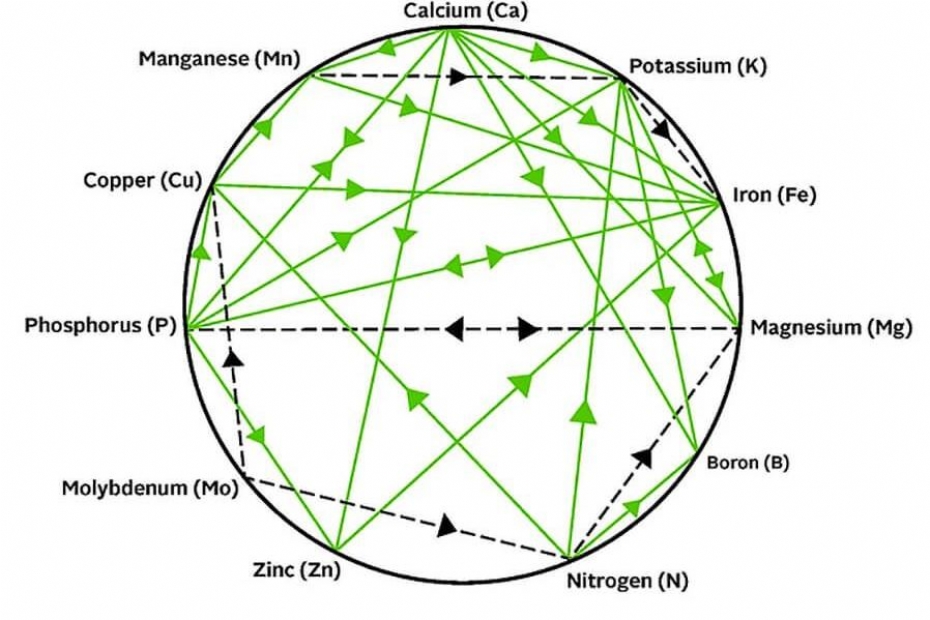
Visible contamination, such as algae or soil particles, is easily recognised by managers. But the real challenges lie in the chemical composition of water. This affects how products dissolve, how they work and how nutrients remain available in the soil. Timmerman sees that these interactions are often misjudged. Nutrients constantly influence each other, which can lead to unexpected outcomes in, for example, leaf analyses. Timmerman refers to this as the 'circle of confusion'. 'It is almost chemistry,' he says. 'Certain elements reinforce each other, others work against each other.' Phosphate and iron are well-known antagonists, but there are many more interactions. At high bicarbonate levels, for example, calcium and magnesium can precipitate more easily and become fixed, which hampers their uptake. These two elements also largely determine how liquid products dissolve in the tank, as they largely define water hardness. 'Many managers think: I dissolve it in water and the plant will absorb it. But if that water is chemically loaded, as is the case with "hard" water, this does not always work.' For managers, it is difficult to oversee all these interactions. Timmerman acknowledges this himself: 'I also regularly have to look things up to see where certain relationships lie. Sometimes the cause is difficult to trace.'
|
|
'You sometimes see plants hardly absorbing certain elements. The cause is often in the water.'
| |
|
According to Timmerman, a water analysis is a logical first step in striving for good water quality. The timing depends on the type of water. Groundwater is usually stable, but surface water can fluctuate strongly. 'Analyse it before you enter a period with intensive irrigation or spraying,' he advises. 'That prevents products from working less effectively or nutrients from becoming fixed in the soil.' To check whether the plant is actually absorbing nutrients, he recommends regular leaf analysis. Leaf analysis results give managers a better basis for adjustments. 'You sometimes see plants barely taking up certain elements. The cause is often in the water,' he explains. Technology is developing rapidly. 'For now, you still have to send soil and leaf samples to a lab,' says Timmerman. 'But there are already devices that allow you to measure certain elements on site.' Sensor technology on drones and machines also increasingly enables large-scale monitoring, allowing more frequent and precise assessment of what a plant needs during the growing season.
|
|
'We can work in a more targeted way, with small quantities, tailored to the weather and the needs of that moment.'
| |
|
The use of field sprayers is increasing. Not only for crop protection, but increasingly also to apply nutrition and biostimulants in small quantities. This requires good water. 'That is a positive development,' says Timmerman. 'We can work in a more targeted way, with small quantities, tailored to the weather and the needs of that moment.' But the quality of the water in the mixing tank determines whether it is effective. If products do not dissolve or react chemically straight away, precision is lost. This has particular impact during busy periods, such as overseeding in summer. Young plants then need phosphate, for example. If irrigation water contains a lot of iron, that phosphate is fixed and no longer available. 'You do apply nutrition, but it doesn't reach the plant,' says Timmerman.
Timmerman sees a clear, manageable approach that managers can follow to maintain or improve their water quality. The first step is checking the installation. Filters and systems that reduce bicarbonate levels or hardness can bring immediate improvement. In areas with very poor water quality, additional technologies are sometimes installed, often in consultation with irrigation specialists. The second step is seeking advice on nutrition and fertilisation, partly based on a water analysis. A specialist can assess which elements influence each other and how nutrition can be adjusted.
|
|
'We will monitor more often and more precisely.'
| |
|
In winter, attention shifts to excess moisture. Infiltration agents can help keep surfaces drier. Dew suppressants are mainly used on closely mown surfaces and in stadiums. Nutrition during this period is limited to situations where grow lights are used, such as in stadiums. 'When using lights, you have to keep feeding. Otherwise, you exhaust the plant,' says Timmerman. According to him, the shift towards data-driven maintenance will continue in the coming years. 'We will monitor more often and more precisely,' he says. 'The most important thing is knowing what to do with the data. Then you can work more targeted and prevent problems earlier.'
The role of the precision spreader
According to Mark Timmerman, the introduction of the Earthway SR2000 fits well within the trend towards more accurate maintenance. This spreader model is already widely used on golf courses in Europe. Thanks to an even spread pattern and perfectly adjustable dosing, the machine is suitable for fine fertilisers and grass seed. 'If we are talking about precision, this is the spreader that delivers the best result,' says Timmerman. The machine makes it easier to work uniformly, especially in areas where manual top-up or uneven dosing can cause problems. In this way, the spreader supports the aim of more targeted maintenance and less waste.
|
This article was previously published on 16 December 2025 on the Greenkeeper](https://www.greenkeeper.nl/article/52389/precisie-in-onderhoud-waterkwaliteit-als-vergeten-schakel]Greenkeeper) website.
| LOG IN
with your email address to respond.
|
|
|
| There are no comments yet. |
|
| |
Anyone can place small ads for free through their own account.
Place a free ad
|
|
|
|





