'With the right approach, you can create high-quality turf without chemicals' |
|
|
|
|
 |
| 138 sec |
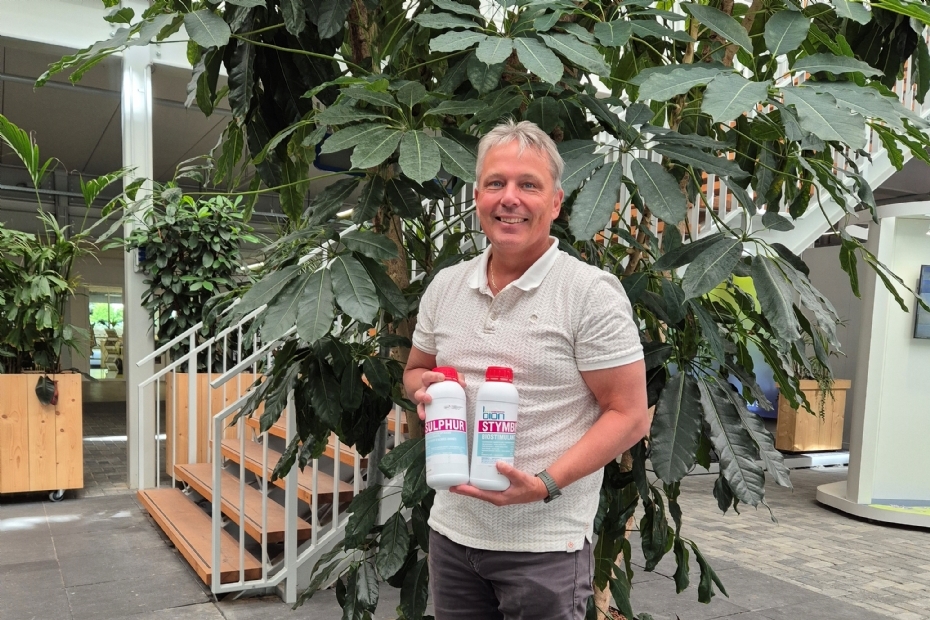
Pressure on greenkeepers and field managers has been increasing for years. Athletes expect a consistently playable surface, golfers demand fast and even greens, while the use of chemical products is being further restricted. The call for sustainability is stronger than ever, but implementation can be complex. In this dynamic, Bion sees opportunities. 'We want to help greenkeepers make their maintenance more sustainable without compromising on quality. In fact, it can result in a stronger and more attractive turf surface,' says Arjen de Haan, who is commercially responsible within the company.
 |
Traditionally, many managers intervene only when diseases such as dollar spot and microdochium (snow mould) become visible. According to De Haan, that approach is no longer future-proof. Bion advocates a preventive strategy rather than a curative one. 'Healthy turf starts with a strong foundation: soil life, root development, water management and balanced nutrition. If that foundation is right, a plant can withstand much more,' he explains. This principle forms the basis of the programmes Bion has developed in recent years.
For the two most common turf diseases, Bion developed specific product lines. The Stymbion line focuses on dollar spot and consists of biostimulants designed to structurally increase plant resilience. 'With Stymbion, we start months before the risk season. You build a plant that is strong enough to cope with pressure,' says De Haan. The combination of amino acids, sulphur and iron supports a more vital turf plant. For microdochium, Bion uses the Greenbion line, based on liquid green fertilisers such as Liquid Iron and Liquid Calcium. Iron lowers the pH level in the soil around the infection site, while calcium strengthens cell walls. Applications start from May in a regular rhythm to maintain resilience throughout the season.
|
|
'You need to organise your overall maintenance strategy more intelligently.'
| |
|
De Haan stresses that sustainable turf care is never about one product or one action. It requires an integrated approach. 'If you simply add three new products to an existing schedule, it becomes too expensive for many fields. You need to organise your overall maintenance strategy more intelligently,' he says. That includes more efficient fertiliser use, active stimulation of soil life and better support for root growth and water management. By combining these elements, managers can often reduce fertiliser inputs without lowering turf quality.
Stable turf depends on proper water management. Excess water increases fungal pressure, while drought stress limits nutrient uptake. To address this, Bion developed the AQBion line, consisting of wetting agents that improve water distribution and retention. 'In dry periods, you prevent water from draining away too quickly. In wet periods, it does not remain on the surface. That makes the whole system more stable,' says De Haan.
Product development
Bion collaborates with R&D departments of partners to develop its own blends in line with the company's vision. The company works with greenkeepers and turf specialists, including experts in biostimulants and sustainable maintenance programmes. Practical experience and scientific knowledge form the basis of the programmes rolled out in the Netherlands and Belgium.
In Wallonia, Belgium, a ban on chemical products for greens and sports fields is already in place. According to De Haan, this illustrates how quickly the sector is changing. He expects similar developments in the Netherlands and emphasises the importance of investing in knowledge and sustainable alternatives in time.
|
|
'The shift towards greener maintenance is only accelerating. We want to stay ahead together with our clients.'
| |
|
De Haan describes Bion's position as focused on speciality fertilisers, biostimulants and water management. The company supports complete maintenance programmes, provides on-site guidance and bases its advice on analyses and field trials. According to De Haan, this aligns with the ambition of greenkeepers and field managers to achieve high-quality playing surfaces in a sustainable way.
Bion is also developing new products, including Stymbion Silicium, a blend of micropeptides, free L-amino acids and silicon aimed at strengthening cell walls and improving crop resilience. New bio-fertilisers are under investigation as well. According to De Haan, the transition to greener maintenance will continue to accelerate in the coming years.
This article was previously published on 18 February 2026 on the website](https://www.fieldmanager.nl/article/53011/met-de-juiste-aanpak-kun-je-zonder-chemie-een-prachtige-grasmat-neerleggen]website) of Fieldmanager.
| LOG IN
with your email address to respond.
|
|
|
| There are no comments yet. |
|
| |
Anyone can place small ads for free through their own account.
Place a free ad
|
|
|
|





