Insect-friendly mowing with the Major Cyclone belt rake combination |
|
| GARDEN AND PARK TECHNOLOGY |
|
|
|
|
 |
| 195 sec |
Revised code of conduct
Around 60 invited guests attended a demonstration in early October 2025 of the Major Cyclone rotary mower with belt rake. Roelof Huizing Cultuurtechniek had this combination machine constructed by Landbouwmechanisatiebedrijf Broekema in Zweeloo. The development is closely linked to the revised code of conduct of the water authorities.
This article was previously published on February 19, 2026 on the website of Stad + Groen.
Roelof Huizing Cultuurtechniek in Zwiggelte specialises in watercourse maintenance and was looking for an alternative mowing machine to respond to changes in the water authorities' code of conduct. The aim is to maintain and strengthen the company's position as a specialist in the region. Since 1 April 2025, the use of flail mowers must be kept to a minimum under the revised code of conduct, in order to mow verges and ditch banks more efficiently and in a more insect- and environmentally friendly way.
|
|
'We must comply with the water authorities' code of conduct.'
| |
|
Roelof Huizing explains: 'We specialise in ditch maintenance, nature and forestry work, earthmoving and civil engineering. In watercourse maintenance, we have been active for more than twenty years for several water authorities in the province of Drenthe. We must comply with their code of conduct. For mowing work, we chose the rotary mower that best fits within that framework. We have extensive experience and passion for this sector; that is why we wanted to develop a well-functioning machine: one that complies with legislation and regulations and - equally important for contractors like us - is user- and maintenance-friendly. The result is a mowing combination that protects insects and small living creatures, which supports biodiversity objectives. I also observe that compliance with the code of conduct, efficiency and low maintenance costs are becoming increasingly important in this market. The more robust and lighter such a mowing machine is, the better.'
Combining expertise
Huizing's company had the honour of demonstrating the new mowing combination. Joint clients were invited, including representatives of water authorities and municipalities. Huizing: 'We took the initiative. As we have four contracts with different water authorities, we were looking for an alternative to our flail mowers. That is how we came into contact with Johannes Ballast, salesman at Major, and Marcel Komduur of Landbouwmechanisatiebedrijf Broekema. Their mechanical engineering expertise, our experience working for water authorities and the regulations of the new code of conduct together resulted in this excellent, well-performing mowing combination. It shows how smart adaptations to existing machines can significantly increase the effectiveness of watercourse and verge management.'
Field testing
Designer Marcel Komduur, working at Broekema, confirms that the jointly developed combination complies with the code of conduct. The operation of the 2-metre-wide mower with hydraulically foldable belt rake has already been tested by the University of Applied Sciences in Soest, Germany. For the Netherlands, however, the Kleurkeur assessment is more relevant. According to those involved, the certifying body, De Vlinderstichting, will include this combination in its trials in 2026. If the results are positive, the machine may receive the Keurkleur Groen certificate.
|
|
'Naturally, this also saves contractors time and fuel.'
| |
|
It has been widely researched and proven that a rotary mower is more considerate of insect life than a flail mower. If the cut material is raked together in the same pass, insect life is spared even further, as insects are not exposed a second time to potentially harmful machinery. Keurkleur Groen certification also saves contractors time and fuel, which benefits the environment. During such certification tests, the assessing body places numerous wax rods in several test plots. The extent to which these are damaged by the mowing and belt rake combination determines the level of harm to insects and other living organisms. More information can be found here.
Modifications
Komduur explains about the newly constructed combination: 'The Major Cyclone is essentially an existing rotary mower. The machine performs the work previously done by flail mowers. I will not go into all the details, but in the mowing section there is modified crop guidance. We also adjusted the discharge opening and the ground guidance. In addition, the hydraulics for the mowing section and the hydraulically foldable and driven belt rake were adapted. These had to be aligned with the Herder mowing arm used by this contractor. For this combination, the required oil supply is at least 100 litres per minute at a pressure of 300 bar.'
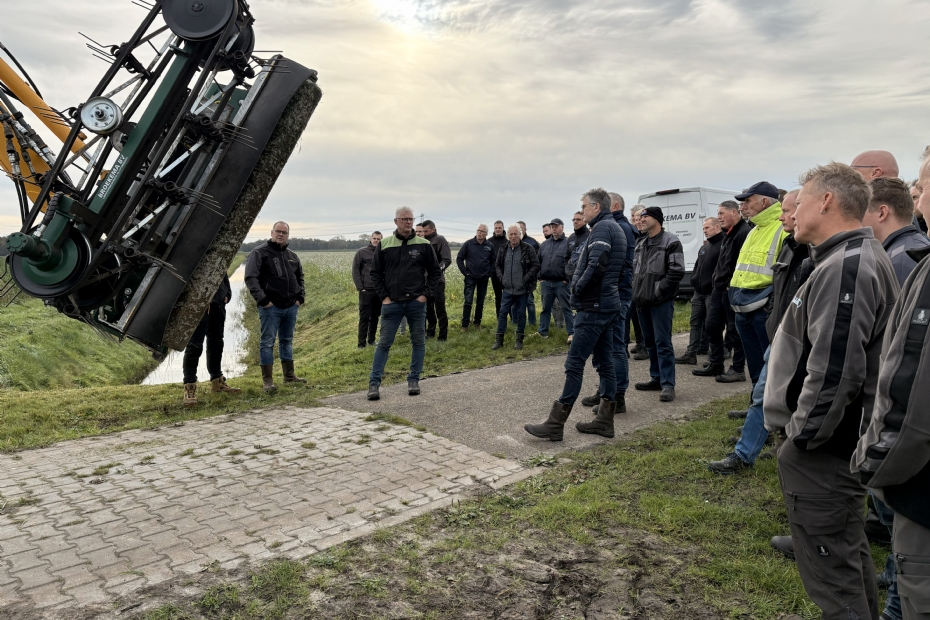 | | The belt rake, over 2 metres long, is positioned directly behind the mowing unit |
|
|
The 2-metre-wide trailed rotary mower has been converted into a mounted rotary mower with a belt rake of more than 2 metres directly behind it. Komduur: 'That makes the combination very compact. The system is also relatively simple in design. During the trials in Germany, wear proved minimal and maintenance costs low. As a result, the combination is a full-fledged replacement for the flail mower in situations where "minimal use" is not possible. The mowing combination is also economically attractive for contractors working in vulnerable water areas.' The designer adds that Major Equipment in Ireland is currently working on the technical drawings. A 150 cm-wide Cyclone belt rake combination with two mowing spindles is being built. 'It must be just as robust and compact, but several hundred kilograms lighter. We are also working on weight reduction for the 200 cm-wide version with three mowing spindles,' says Komduur.
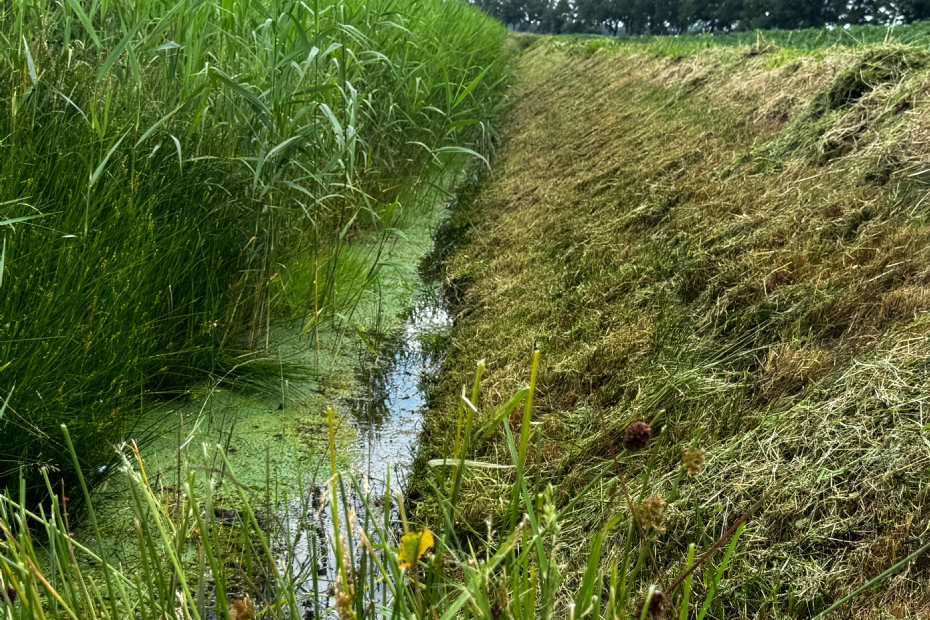 | | The result in a single pass speaks for itself |
|
|
New application
With the traditional trailed Major Cyclone, significant savings in engine power and fuel can be achieved. Moreover, these mowers demonstrably spare wildlife in grass crops. They feature a maintenance-friendly hydraulic end drive and are built strong and robust. This makes them highly suitable for the maintenance of forests, road verges and other natural areas. The machine can also handle woody growth, shrubs, reed, rush and weeds, as well as shredding green manures and crop residues such as maize and rapeseed. Following this Major concept, Landbouwmechanisatiebedrijf Broekema therefore built a 2-metre-wide version for use with a Herder mowing arm.
|
| Stichting Groene Erkennin... | |
| |
| LOG IN
with your email address to respond.
|
|
|
| There are no comments yet. |
|
| |
Anyone can place small ads for free through their own account.
Place a free ad
|
|
|
|





