Circular lava is possible, but the market must be willing |
|
| GARDEN AND PARK TECHNOLOGY |
|
|
|
|
 |
| 281 sec |
Municipalities express their sustainability ambitions. Yet circular lava, developed through cooperation between CSC Sport, contractor Smits & de Kleijn (SDK) and processing company GSCN, is often excluded from tenders. Why is that? Especially with the deadlines approaching for a circular economy in 2050.
| CSC Sport project at DHM Dordrecht 2023, the project after the first project at MHC Weesp |
Traditionally, many sports technical base layers of artificial turf fields consist of lava mixed with rubber. During renovations this layer was for many years completely excavated and removed. In recent years this practice has accelerated due to municipalities wanting to ban rubber from the subsoil, partly because of concerns about the leaching of SBR rubber and the public debate that followed reports in programmes such as Zembla. As a result, specifications increasingly prescribe that sports technical lava/rubber layers must be excavated and removed. This removes not only the rubber but also large quantities of technically usable lava from the chain.
Silvio van Doorn, operational director of CSC Sport, explains: 'During renovations huge volumes of material became available that were technically still perfectly usable, while at the same time we had to extract new lava from quarries in Germany. That creates tension. In addition, old lava/rubber layers often ended up in a grey area, for example mixed into large piles of concrete rubble or mixed granulate. If such a pile is large enough, the rubber is automatically diluted. But that is not the way CSC Sport, as part of TenCate with its high sustainability and circularity ambitions, wants to operate.'
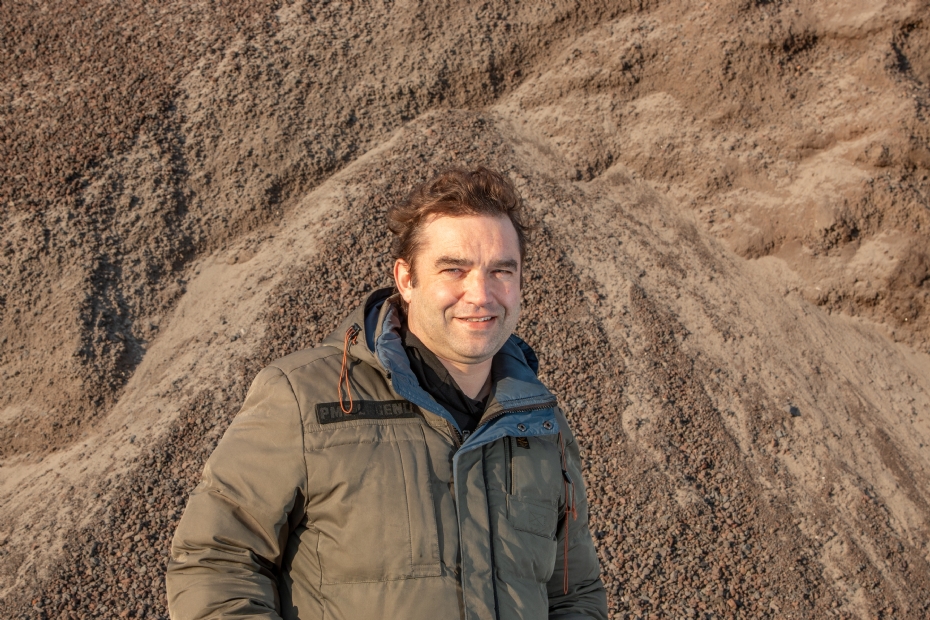 | | Sjoerd Smits |
|
|
Circular alternative
CSC Sport and Smits & de Kleijn decided things had to change. In 2023 Smits & de Kleijn and GSCN started a certified recycling process under the GSCN certificate. Smits & de Kleijn removes the existing lava/rubber layer, separates it, washes it and prepares it again for use as a sports technical foundation. CSC is the largest customer of Smits & de Kleijn, but the system is explicitly open to the entire market: other contractors can also supply and purchase material. Van Doorn: 'This keeps the raw material in the chain and prevents waste or downcycling. You know exactly what happens to the removed material and where it ends up, instead of disappearing into a grey area.'
In principle, circular lava can be used in the construction and renovation of all artificial turf sports fields. However, there are situations where Smits & de Kleijn and CSC Sport do not recommend it. Sjoerd Smits of Smits & de Kleijn: 'Last year the standard for hockey was tightened. As a result, our product is currently less suitable unless you explicitly take this into account at the design stage.' This tightening is not so much related to sports technical performance but to the formal framework. In its new standards, the KNHB requires a complete testing and declaration basis according to the current quality system. These formal product declarations are not yet fully available for circular lava, even though the material technically complies.
|
|
'We still ask the question in the specification, but we usually already know the answer.'
| |
|
 | | The installation |
|
|
Capacity, volume and ambitions
SDK processes the material together with GSCN in a large screening and washing installation. The installation operates all year round but has limited capacity. Scaling up therefore requires time, space and stock. Sjoerd Smits, director and owner of Smits & de Kleijn, is clear about this: 'For us this initiative is successful if we can actually process all lava/rubber material that we take in and reuse it at a high level.' Each year the company takes in around 35,000 tonnes of lava with rubber from main client CSC, but also from other market parties. Other mixed streams are also processed in the installation, such as sand rubber. After certified processing each material receives its own destination: sand is used for raising levels in civil engineering projects, rubber is used as fuel, and from the lava-rubber stream 21,000 to 25,000 tonnes of clean lava remain. 'We want to return those 21,000 to 25,000 tonnes 100 percent to sports fields as a sports technical foundation,' says Smits. 'You can also apply circular lava as tree substrate or water storage, but we deliberately do not want to downcycle. Why would you do that if the material is perfectly suitable for sports fields?'
|
 | | Silvio van Doorn: 'If all doors are immediately closed to an application like this, the market cannot keep improving until we reach where we want to be.' |
|
|
Learning curve
Before the first pilot, the Environmental Service of Amsterdam and the municipality of Utrecht indicated that 99 percent rubber-free would be acceptable. In practice this turned out not to be convincing enough visually in the first project at MHC Weesp: rubber granules were still visible here and there in the top layer. Smits is open about this: 'At MHC Weesp we saw that the separation had to be sharper. That was a valuable learning moment and it is part of the process to make adjustments at the start.' SDK then optimised the process and doubled the washing process, resulting in lava that is 99.9 percent rubber-free.
 | | Excavation of the sports technical layer by Smits & de Kleijn |
|
|
Obstacles
Reusing lava prevents new extraction and transport from abroad, but washing and screening also requires energy. According to Smits, a full life cycle assessment (LCA), in which all steps are calculated - for example CO2 reduction per tonne of lava or per field - is not yet available. This SMART substantiation is essential to give buyers and specification writers support when making innovative choices. Smits acknowledges this openly: 'An LCA is planned for next year. We need it to make the story really solid.'
Because the breakthrough of circular lava is still pending. Despite process improvements and independent quality control by SGS Intron, CSC Sport and Smits & de Kleijn see that circular lava is still regularly excluded in tenders. Specifications sometimes state that circular material is not allowed or that the foundation must be completely free of foreign materials in the soil. According to Smits this is problematic, not because the product falls short technically but because it deviates from what is familiar. 'Of course the safety of the athlete and optimal sports technical properties always come first, and we are aware of the public concerns about rubber in the past. But the real obstacle is that specification writers often choose solutions they know as legally safe options under the idea that unfamiliar means undesirable,' he says. Suppliers of virgin materials therefore remain strongly positioned in the sports field market. Van Doorn recognises this: 'Consultants or specification writers avoid risks. The result is that contractors invest in innovation but cannot easily earn that investment back while the market remains closed.' Smits confirms that the system works. Despite the limited processing capacity, washing can take place all year round and intake and output peaks create buffers. But if demand remains low the system may eventually become economically unviable. 'That would be a shame, because then we would have to close the proverbial gate.'
|
|
'The clock towards sustainability in 2030 and 2050 keeps ticking.'
| |
|
Call
Both parties call for room in specifications for circular materials that demonstrably meet quality requirements. Van Doorn: 'Stopping circular raw materials is becoming harder to justify, because the government's sustainability targets are already fixed: a strong reduction in the use of primary raw materials by 2030, and fully CO2-neutral construction and a 100 percent circular construction economy by 2050.' Smits adds: 'Yet sports field construction still largely relies on virgin lava, as if time is not a factor.'
This does not stop the parties from continuing their efforts for change. Van Doorn: 'Circular lava is being slowed down by regulations. We could easily sit back, but if we really want to make a difference in 2030, we want to be among the parties willing to stick their necks out.' He adds: 'Perhaps we should adjust the standard for lava so that it is not considered a foreign material in the soil, unless it exceeds 0.01 percent of the total. That is an action I can and will raise on behalf of CSC Sport within the working group BSNC. But the real shift will have to come from specification writers.' Smits agrees: 'Give a fictional discount for circular raw materials, just as is done now for electric equipment. Even if it is only 1 or 2 percent. We fully understand that standards exist for safety and sports technical requirements, and we guarantee those. But beyond that we can either make things difficult or easier for each other. Let's choose the latter so that the circular construction economy can finally start moving.'
This article was previously published on 5 March 2026 on the Fieldmanager](https://www.fieldmanager.nl/article/53027/circulaire-lava-kan-maar-de-markt-moet-durven]Fieldmanager) website.
| LOG IN
with your email address to respond.
|
|
|
| There are no comments yet. |
|
| |
Anyone can place small ads for free through their own account.
Place a free ad
|
|
|
|





