Red fescue requires restraint and craftsmanship |
|
|
|
|
 |
| 241 sec |
Red fescue offers clear advantages. It is drought tolerant, disease resistant and requires less maintenance than many other grass species. Still, it is not a standard solution for every golf course. This is evident from the experience of head greenkeeper Kees IJsselstein at golfbaan Bentwoud. He has worked with red fescue for nearly thirty years and knows: 'Sometimes it is better to do nothing, even though that feels very unnatural for a greenkeeper.'
| Erik Dolstra of DLF and Kees IJsselstein of AHA de Man. |
Bentwoud uses red fescue from grass seed breeder DLF. The company ranks high in the Grass Guide with several fescue varieties. That does not change the fact that continuous research is carried out at the trial station in Moerstraten and on golf courses in Denmark. 'We want to make it even more resistant to disease pressure from dollar spot and fusarium,' says Erik Dolstra, turf expert Benelux at DLF. He explains the advantages of this grass species and what greenkeepers need to do to succeed: 'My advice is to interfere as little as possible during maintenance.'
IJsselstein first encountered the species nearly thirty years ago at Golfbaan Ockenburg. The dune course provided an ideal poor soil for fescue. 'I was already able to manage it well there. It simply gives a very nice turf,' says the head greenkeeper of AHA de Man. His move to Kralingen felt like entering a different world. The peat soil of this low-lying polder course was wet, soft and unsuitable for fescue. After a period at Krimpenerhout, again with fescue greens, he moved to Bentwoud, where the choice for red fescue had already been made. He supervised the greens from seeding to first play, gaining in-depth knowledge of the species.
|
|
'The most important thing is to be very careful with irrigation'
| |
|
The core of his approach is simple: restraint. 'Very careful with fertiliser. Very sparing. No phosphate.' But water is the key factor. 'The most important thing is to be very careful with irrigation.' Instead of frequent light applications, he does the opposite. 'When I irrigate, I apply a lot. Around 9 millimetres. Then I wait as long as possible.' He avoids light irrigation night after night. According to IJsselstein, this actually simplifies maintenance. But simple does not mean easy. The biggest challenge lies in the behaviour of the greenkeeper. 'You always think you have to do something. But sometimes it is better to do nothing, and that is the hardest thing.'
Precision
According to Dolstra, this is exactly where the difference with other grass species lies. 'With red fescue, it is more about precision.' Less input does not mean less attention, but more targeted management. Everything revolves around dosing: water, nitrogen and operations. This is where things often go wrong in practice. IJsselstein mentions examples he still hears regularly, such as verticutting in early spring. 'That is absolutely out of the question.' He has not done it for years. Aggressive practices such as grooming also do not fit red fescue. 'If you want to maintain fescue, you should not do that.' Too much intervention has the opposite effect. 'You start favouring the wrong grass, especially annual meadow grass.'
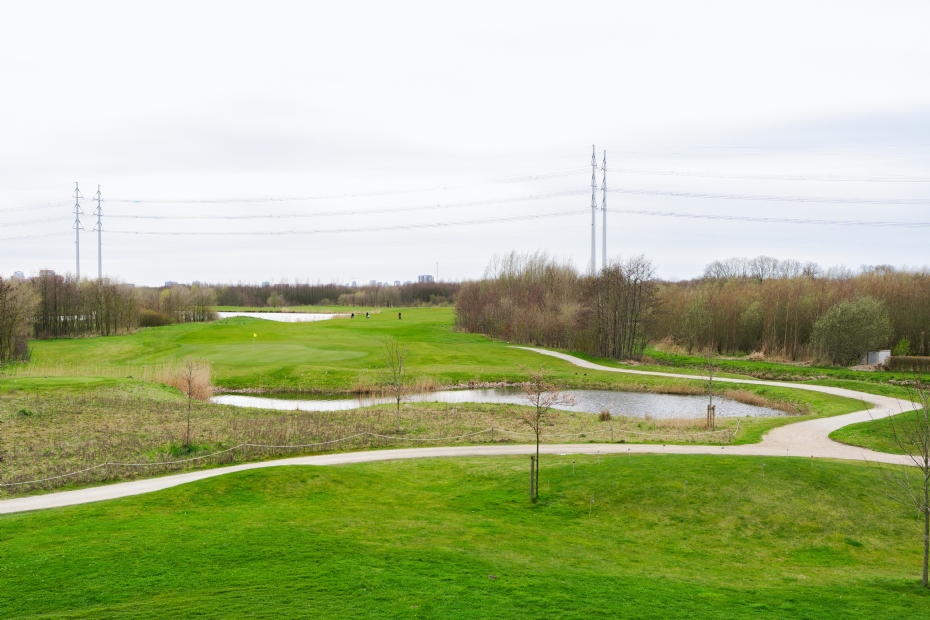 | | Golf course Bentwoud |
|
|
Red fescue is not suitable everywhere. Its appearance alone is a factor. 'These are not the bright green greens you can achieve with bentgrass,' says Dolstra. Red fescue looks more natural and changes colour with the seasons. 'You have to appreciate that.' For parkland courses where a uniform green look is required, pure fescue is less suitable. For a more natural course image, it is a good fit. Soil conditions are also decisive. Good drainage is essential, according to IJsselstein. 'In wet areas, it simply will not work.' On heavy, wet soils, seeding makes little sense.
|
|
'We mow the greens four times a week'
| |
|
Bentwoud is one of the busiest courses in the Netherlands, with around 150,000 rounds per year. According to IJsselstein, fescue is sensitive to wear, especially in winter. Smaller putting greens are therefore closed during that period because they cannot handle the pressure. Larger greens allow wear to be spread through varied pin positions. Once temperatures rise and growth resumes, red fescue recovers more quickly. In summer, the grass performs better despite intensive use. The load is high, with lessons and clinics from early morning until late evening. Still, quality remains stable. An important advantage of red fescue is the lower maintenance demand due to slower growth. 'We mow the greens four times a week,' says IJsselstein. With bentgrass, this is six to seven times. On a large course, that saves considerable time. In dry periods, mowing can even be skipped. These benefits fit a broader trend: less mowing, less water and less fertiliser mean lower inputs. According to Dolstra, this aligns with the demand for more sustainable management. IJsselstein agrees. 'If you manage red fescue, you are already working sustainably.'
Heat is an important concern. Red fescue tolerates drought well, but less so extreme temperatures. 'It cannot handle 35 degrees very well,' says IJsselstein. This became clear in 2018. During prolonged heat, growth stops completely. 'It simply shuts down.' The grass survives but does not actively recover. 'If you lose it, it is very difficult to get it back.' The approach to prevent this is simple: keep it alive. Hand watering is used to help the turf through the stress period. If that succeeds, the grass recovers naturally. 'If you keep it alive, it will come back,' IJsselstein knows from experience. Play continues even during extreme summers. Greens become hard and difficult to play. 'They really became like concrete slabs.' In terms of diseases, red fescue offers major advantages. IJsselstein has not used fungicides for thirteen years. 'Fusarium? I do not have any issues with it.' Dollar spot is also rare at Bentwoud. Red thread does appear every spring, but he sees it mainly as a visual issue. 'At first it looks a bit like dollar spot, but it is not harmful. I no longer worry about it.' He deliberately avoids applying nitrogen to improve appearance, as that works against the species.
|
|
'You do not maintain red fescue by doing more'
| |
|
In spring, clover growth is one of the main threats to red fescue, according to IJsselstein. Clover develops quickly while red fescue is still dormant, and it benefits from nitrogen in the air. 'It starts to spread rapidly,' he says. Mechanical removal sometimes works, but not in large patches. Chemical solutions are limited. For courses with high clover pressure, red fescue is therefore less suitable. The key question remains: for which courses is red fescue the best choice? According to Dolstra, it is most suitable for well-drained courses with a natural look, preferably links-style. Mixtures with other grass species can also be a good solution. IJsselstein stresses that no course should see red fescue as an easy alternative. It requires knowledge, patience and a manager who understands that success does not come from doing more, but from doing less. 'You do not maintain red fescue by doing more,' he says. 'You maintain it by doing less.' Meanwhile, DLF is working in Denmark on future red fescue varieties, focusing on higher disease tolerance, less thatch formation and better performance under changing climate conditions.
This article was previously published on 16 April 2026 on the Greenkeeper](https://www.greenkeeper.nl/article/53618/roodzwenk-vraagt-om-terughoudendheid-en-vakmanschap]Greenkeeper) website.
| LOG IN
with your email address to respond.
|
|
|
| There are no comments yet. |
|
| |
Anyone can place small ads for free through their own account.
Place a free ad
|
|
|
|





