A koi pond requires more than a nice hole: these five mistakes can cost you later |
|
| GARDEN AND PARK TECHNOLOGY |
|
|
|
|
| Lotte Mulder,
Friday 25 September 2026 |
 |
| 142 sec |
Building a koi pond requires a different approach from creating a regular ornamental pond. The technology behind the system determines whether the pond will continue to function properly for years or quickly develop problems. Kees Kuijpers of Vijvercentrum sees which mistakes are most commonly made in practice and shares five key points for design and construction.
| Building a koi pond requires a different approach from creating a regular ornamental pond (AI) |
A koi pond should not only look attractive, but also provide a stable environment for the fish. This starts at the design stage. 'Many problems are not caused by poor maintenance, but by mistakes made during construction', says Kuijpers. 'Making the right choices at this stage can prevent a lot of costly repair work later.'
1. Start with sufficient volume
A common mistake is building a koi pond that is too small or too shallow. Koi produce a lot of waste and require sufficient water volume. Temperature and water parameters also fluctuate more quickly in a small pond. As a rule of thumb, Kuijpers recommends at least 1,000 litres of water per koi and a depth of 1.2 to 1.5 metres. According to him, a serious koi pond will quickly require a volume of 5,000 litres or more. 'More volume provides greater stability', says Kuijpers. 'It gives the system more capacity to absorb small fluctuations.'
2. Do not cut costs on the filtration system
According to Kuijpers, the filtration system also regularly receives too little attention. A system that appears to be exactly sufficient for the pond volume on paper often turns out to be too small in practice for a pond containing koi. When sizing the system, it is therefore important to consider not only the volume of water, but also the number of fish and the amount of feed.
As a rule of thumb, Kuijpers recommends that the pump circulate the entire pond volume at least once every two hours. At the same time, the filter must remove both solid waste and break down ammonia and nitrite. 'Replacing a filter after the pond has been completed costs much more than making the right choice from the start. It is therefore better to choose a slightly oversized system than one that is too small.'
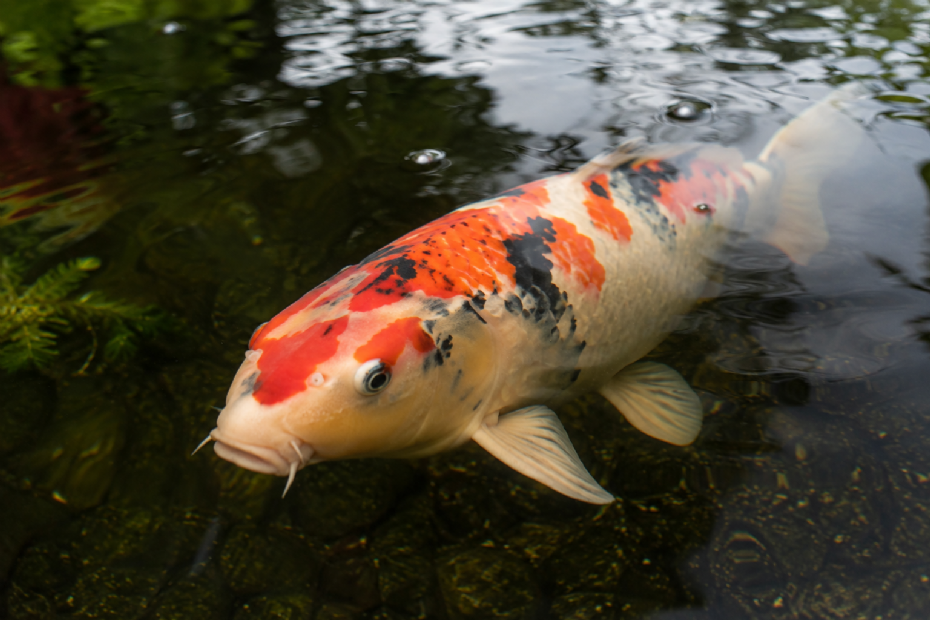 | | Koi |
|
|
|
|
'Many problems are not caused by poor maintenance, but by mistakes made during construction.'
| |
|
3. Give the system time
After construction, a pond needs time to develop a biological balance. The bacteria that break down ammonia and nitrite only build up gradually. According to Kuijpers, it takes around four to six weeks for these bacteria to become sufficiently established. Adding large numbers of koi immediately and feeding them heavily increases the risk of an ammonia spike and water quality problems. 'Starting up slowly will ultimately result in a more stable system.'
4. Measure more than just water clarity
Clear water does not automatically mean that the water quality is good. Kuijpers therefore recommends regularly checking the most important water parameters during the initial period. According to him, ammonia and nitrite should remain at zero. He also recommends a carbonate hardness (KH) of at least 6 and preferably 8 or higher. This helps prevent the pH from dropping too sharply.
During the first season, Kuijpers recommends checking the values weekly using a liquid drop test. 'Testing prevents you from making decisions based on guesswork. It allows you to identify problems before they start affecting the fish.'
5. Think ahead when designing the pond
Maintenance should also be considered during construction. A filtration system that is difficult to access or a lack of provisions for removing waste can make future maintenance unnecessarily complicated. Kuijpers therefore recommends including a bottom drain or skimmer in the design, using sufficiently large pipework and providing an easily accessible location for the filtration system. According to him, moving a filter or installing a bottom drain afterwards costs many times more than including these features during construction.
'When designing the pond, think ahead about accessibility and maintenance. This prevents major modifications once the pond has been completed.'
Kuijpers stresses that a koi pond requires specialist knowledge. 'Take the technical side just as seriously as the rest of the design. Having the design checked beforehand takes little time and can prevent significant repair costs.'
This article was previously published on 25 September 2026 on the De Hovenier website.
| LOG IN
with your email address to respond.
|
|
|
| There are no comments yet. |
|
| |
Anyone can place small ads for free through their own account.
Place a free ad
|
|
|
|





