Drip irrigation for sports fields appears to work, now the technology needs fine-tuning |
|
| GARDEN AND PARK TECHNOLOGY |
|
|
|
|
 |
| 350 sec |
More measuring means more knowledge
Subsurface drip irrigation appears to work as a low-cost and sustainable alternative to traditional pop-up irrigation on sports fields, but how can you get the most out of it? During a knowledge session organised by Fieldmanager magazine at VOGIDO football club in Enschede, field managers and irrigation specialists discussed the subject. Water savings, soil moisture, sensors, water quality and system control were all addressed. The conclusion: the potential is considerable, but there is still a lot to learn.
| VOGIDO knowledge session, 10 September 2026 |
The principle is simple. Instead of irrigating the field from above with pop-up sprinklers, drip lines deliver water below ground. At VOGIDO, the lines are installed at a depth of around 26 centimetres and spaced 60 centimetres apart. The lines contain emitters, or drippers, that release controlled amounts of water into the soil. Capillary action then distributes the moisture towards the root zone.
At VOGIDO, Water4All uses Toro Neptune pressure-compensating drip lines supplied by Heybroek. In this case, a type of line was selected with emitters spaced 40 centimetres apart, each delivering one litre of water per hour. Pressure compensation ensures that an emitter at the beginning of a line delivers the same amount of water as one at the end. This makes it possible to irrigate large areas evenly.
No groundwater available
It was no coincidence that the system was installed at VOGIDO. Sportaal is responsible for outdoor sports facilities in Enschede and manages thirty natural grass football pitches. At three sports parks, groundwater is either unavailable or unsuitable for pumping. VOGIDO is one of them. For years, the solution was far from sophisticated and certainly not sustainable: water was brought in by tractor and slurry tanker and then spread across the pitch, resulting in additional transport, labour and evaporation losses. Rutger-Jan Hesselink and Tonnie Doek of Sportaal therefore started looking for another solution. A newspaper article about the use of drip irrigation by Water4All in agriculture gave Hesselink the idea of trying the same technology beneath a football pitch. The trial at VOGIDO started in 2023.
|
|
'We have no secrets. We are happy to share what works, but also the critical points'
| |
|
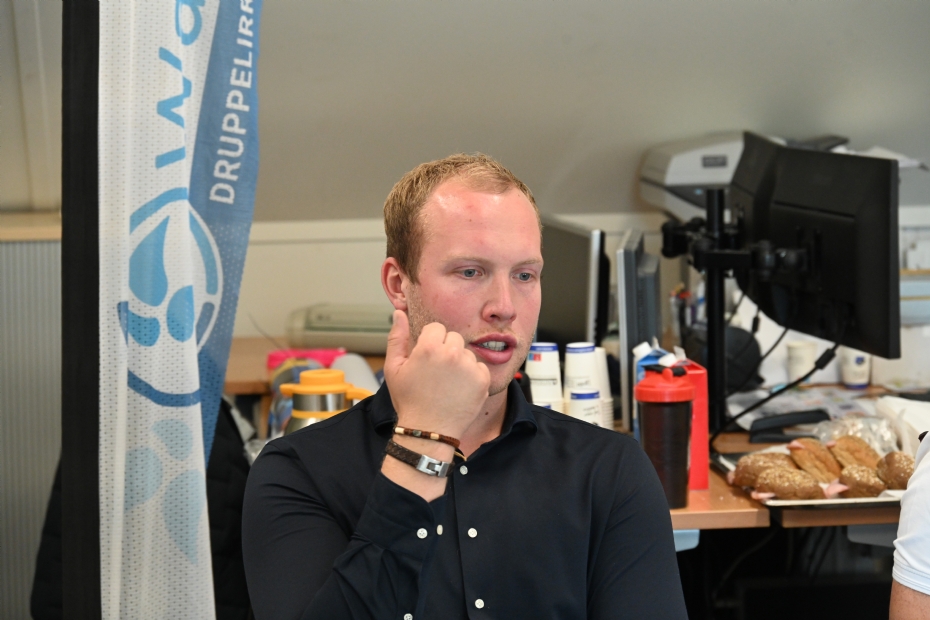 | | Jelle Golbach, Water4All |
|
|
From pilot project to water hub
The drip lines are ultimately only one part of the plan. The municipality of Enschede is developing local water hubs designed to store as much water as possible within the area for use in public spaces. This could be used to water trees, for example, but also to irrigate a sports field. VOGIDO is also set to become such a water hub. The next step is therefore the construction of an underground water storage system using crates with a capacity of around 400 cubic metres. Rainwater from sources including the adjacent artificial turf pitch and tennis hall will be collected there. This water can then be used for drip irrigation of the natural grass pitch. The aim is to largely eliminate the current need to bring in water by tanker. The combination is interesting: during wet periods, water is stored locally instead of being drained away, while during dry periods the same water can be used for the sports field. The municipality now has four water hubs under development and aims to increasingly match local water supply and demand.
The full story
Rutger-Jan Hesselink of Sportaal promised the field managers and irrigation specialists attending the session that they would not get a sales pitch, but the full story. And that is what they got. The trial certainly did not run without *hiccups*. A malfunction temporarily caused one of the three irrigation sections to stop working. The section without drip irrigation became visibly drier than the rest of the pitch. A bigger problem concerns the measurements. The plan was to use soil moisture sensors to determine exactly how much water the grass needed and automatically adjust irrigation accordingly. That connection did not work as intended. As a result, Sportaal has continued to apply the same amount of water throughout the trial.
|
|
More measuring means more knowledge: the optimum amount of irrigation water is still not sufficiently clear
| |
|
Much less water
And yet water savings may offer the greatest potential benefit. During the presentation by Jelle Golbach of Water4all, calculations for a dry period compared around 30 cubic metres per day for drip irrigation with more than 100 cubic metres for traditional irrigation. The difference is easy to explain. With above-ground irrigation, a significant proportion of the water is lost through evaporation and wind. Drip irrigation, by contrast, delivers the water directly into the soil.
For an 8,000-square-metre pitch, 30 cubic metres of water is equivalent to 3.75 millimetres of rainfall. On a hot summer day, according to specialist literature, a healthy, actively growing grass sward can roughly evaporate 3.5 to 5 millimetres of water per day. The 30 cubic metres used in the Enschede calculations is therefore in the same range as the grass's daily water requirement.
 | | Rutger-Jan Hesselink, Sportaal |
|
|
Overseeding becomes more difficult
At the same time, applying water underground has one important disadvantage: sometimes water is needed at the top of the grass sward. This is particularly true after overseeding. The drip lines at VOGIDO are installed more than a quarter of a metre below ground. An established grass plant with a developed root system can easily benefit from moisture rising from this layer. A newly germinated grass seed cannot, or at least finds it much more difficult. During a dry period, Golbach says above-ground irrigation is therefore still needed to help new grass establish.
A related point of discussion during the knowledge session was a seemingly simple question: how far can water actually rise from a drip line installed at a depth of 26 centimetres? There proved to be no single answer. Capillary action depends strongly on soil structure. In coarse sand, for example, water rises much less than in fine sand. In addition, water from a drip line does not only move upwards, but also sideways and downwards. Specialist literature (1) gives a rough indication of 20-50 cm of capillary rise for sand, 50-80 cm for medium-textured soil and more than 80 cm for fine-textured soil. However, even within the category of sand, the differences are considerable: coarse sand may achieve only around 5-15 cm, while fine sand can theoretically achieve 40-100 cm. In principle, it could therefore be possible to provide water even to a newly germinated grass plant. Jelle Golbach does offer a warning. 'With subsurface irrigation, you need to keep the topsoil consistently moist. If you leave it too long, you will need a lot of extra irrigation to get everything back to the right level.'
Clean water is crucial
A second point requiring attention is water quality. Drippers have small openings, making clogging a real risk. Iron in particular can cause problems. Rainwater therefore has an important advantage: it contains no iron. Leaves, sand and other debris still need to be filtered out. According to Water4All, water quality largely determines the lifespan of the installation. Because the lines remain beneath the pitch for many years, clogging must be prevented. Replacing a drip line is, after all, a very different job from replacing a faulty sprinkler at the edge of a pitch.
Many variables still to adjust
This ultimately brought the discussion to perhaps the most important conclusion of the afternoon: the principle works, but the optimum configuration for a sports field has not yet been found. At VOGIDO, the lines are spaced 60 centimetres apart, with drippers every 40 centimetres and installed at a depth of 26 centimetres. But why exactly these distances? What happens if the lines are placed 50 centimetres apart? Could they be installed closer to the surface, bringing the water nearer to the roots? And should the emitters, or drippers, perhaps be placed closer together, with a lower output per dripper?
Every change has consequences. More drippers mean a higher water output and place different demands on the pump and pipework. Installing the lines closer to the surface may improve efficiency, but increases the risk of them being hit during maintenance work. Placing the lines further apart reduces installation costs, but could ultimately result in dry strips. Chris van Aalsburg of AVC Gras en Beregening suggests installing the lines at a depth of 15 centimetres and using a Topchanger for aeration. This type of machine does not aerate mechanically with tines, but uses water injected into the soil at 250 bar. According to Van Aalsburg, this would not damage the drip lines.
|
|
'There are so many variables you can adjust'
| |
|
Investment costs are almost the same
Financially, the two systems are closer than might be expected. During the knowledge session, the cost of a complete field with subsurface drip irrigation was estimated at around €25,000. The VOGIDO field was cheaper because Sportaal carried out much of the work itself. A traditional pop-up irrigation system costs around €17,000, excluding approximately €6,000 for the pump. This puts the total investment at roughly the same level. The financial difference therefore has to come mainly during operation, for example through water and energy consumption and maintenance.
First determine what the pitch really needs
Most of the technology needed to take the next step is already available. Soil moisture sensors, weather data, automatic valves and software could theoretically work together to determine when a pitch needs water and how much. It is even technically possible to control different sections of a pitch separately.
But more technology only makes sense once it is clear what should be controlled. How far does the water actually rise from the drip line? How does this vary with different soil structures? How much moisture does the grass sward need to remain healthy without applying unnecessary water? And how far can irrigation volumes be reduced before pitch quality starts to decline?
After three years of practical experience in Enschede, this is the next step. The aim is no longer to prove that subsurface drip lines can deliver water to the grass, but to measure how much water is needed, where and when. Only with that knowledge will it become clear how efficient the system can really be.
Or, as the discussion at VOGIDO demonstrated throughout the afternoon: more measuring means more knowledge.
Source 1
Irrigation Water Management: Training Manual No. 1 - Introduction to Irrigation by C. Brouwer, A. Goffeau and M. Heibloem for FAO, 1985
|
Investment
| Cost item |
| Subsurface drip irrigation |
| Traditional pop-up irrigation |
| Installation per field |
| approx. €25,000 |
| approx. €17,000 |
| Pump |
| included |
| approx. €6,000 |
| Total investment |
| approx. €25,000 |
| approx. €23,000 |
|
This article was previously published on 12 September 2026 on the Fieldmanager](https://www.fieldmanager.nl/article/55523/druppelirrigatie-voor-sportvelden-lijkt-te-werken-nu-de-techniek-nog-finetunen]Fieldmanager) website.
| AVC Gras en Beregening ... | |
| |
| LOG IN
with your email address to respond.
|
|
|
| There are no comments yet. |
|
| |
Anyone can place small ads for free through their own account.
Place a free ad
|
|
|
|





