From obstacle to walking route: when the sidewalk becomes the gym |
|
|
|
|
 |
| 193 sec |
'A single playing field is not enough to get people outside and moving'
More than six in ten Dutch residents experience barriers to exercising or being physically active outdoors. These barriers are often personal: lack of time, low energy, or health complaints. But the environment also plays a role. Poor lighting, crowding, or impractical routes can be an extra obstacle — especially for young people and people with disabilities.
| From left to right: Mark Noordzij, Robin Rauws and Daniëlle Ruikes, researchers at the Mulier Institute |
A well-designed outdoor environment can help lower such barriers. Green space is not the biggest obstacle, but it is an important part of an attractive and accessible environment. Robin Rauws, researcher at the Mulier Institute and, together with Daniëlle Ruikes and Mark Noordzij, author of the report *So many people, so many wishes*, explains what these insights mean for design and management — and where opportunities lie for green professionals.
Green space in the neighborhood is important
To start with that last point, I ask Rauws what green professionals can practically do with the insights from the study. Are there design or management choices that can really make a difference for exercise-friendly outdoor spaces? 'Green space was a limited focus in our study: about 7 percent of participants experienced a lack of grass fields or other usable green areas as a barrier, and a lack of trees was a barrier for 5 percent. So our research does not give a clear reason to focus more on green space to stimulate physical activity in public space. However, we know from other research, such as data from the National Sports Survey, that green space in the neighborhood is important to people. The fact that a lack of green space did not emerge as a major barrier in our study does not mean that more green space or better-quality green space is not needed.'
|
|
'Almost all barriers discussed in the study were experienced by relatively more young people than by other groups'
| |
|
Fewer barriers
The study shows that many people mainly experience personal barriers. How much influence does the design of public space have on this in practice? And where do you see the greatest gains for designers and managers?
'How much influence the design of public space has on personal barriers (their emergence or possible solutions) depends on the type of barrier. But the design of public space can certainly help people who experience their health or a lack of time as a barrier to being physically active outdoors. For people with little time or low energy, it can help if opportunities for movement, such as a pleasant walking route, are close to home. And for people with a motor disability, it is important that sports facilities and walking and cycling paths are well accessible. You probably cannot solve the underlying problem itself, such as crowding or health issues, through design alone. But you can make sure these barriers are less significant when it comes to being physically active.'
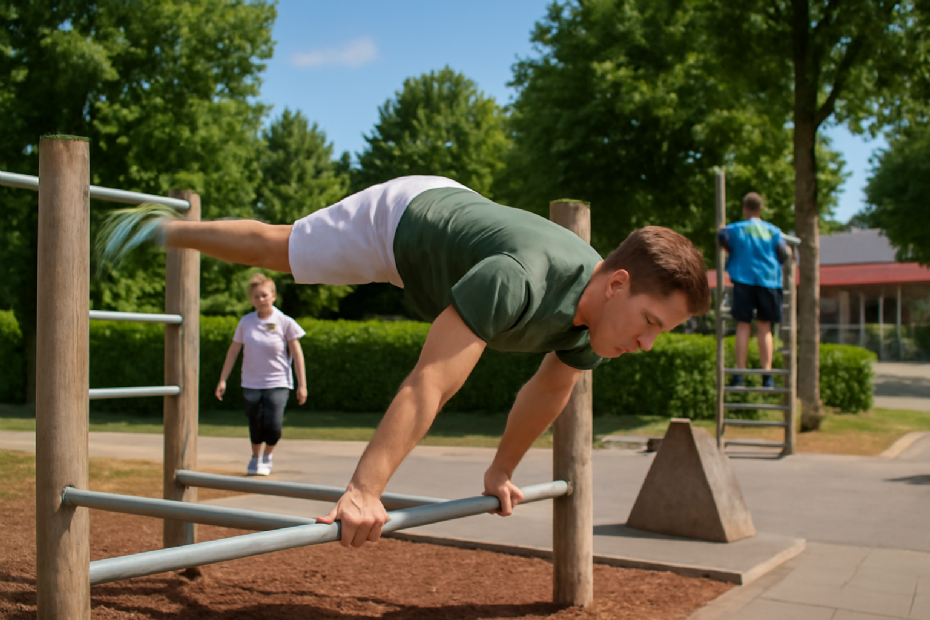 | | Physical activity in public space (image for illustration) |
|
|
|
|
'The fact that a lack of green space did not emerge as a major barrier in our study does not mean that more green space or better-quality green space is not needed'
| |
|
Alignment with preferences and other conditions
What role do specific activity areas — such as sports fields or exercise routes — play in encouraging people to go outside? What works, and what does not?
'That is difficult to say, because specific places for physical activity never exist in isolation. If you want to study whether building a small football field leads to more physical activity among nearby residents, you cannot be sure whether a decrease or increase is due to the field itself or to other places where residents are active. Or perhaps to something that disappeared with the arrival of the football field. That said, specific places can encourage people to go outside, provided they match people's preferences and the other conditions in public space that they find important are in place. Think of traffic safety, social safety, and the attractiveness of the environment. Simply building a play area or sports field is not enough to get people outside and moving.'
|
|
'The design of public space can certainly help people who experience their health or a lack of time as a barrier to being physically active'
| |
|
For young people and in consultation with young people
You mention that young people and people with disabilities experience relatively many barriers. Which design or management principles can help lower thresholds specifically for these groups?
'Almost all barriers discussed in the study were experienced by relatively more young people than by other groups. In summary, young people indicate that they lack time (51%), find sports equipment too expensive (18%), do not like being seen by others while exercising (28%), or experience that there are too many people around places where they would like to exercise (21%). In addition, 25 percent indicate that they miss a sports buddy, 18 percent feel unsafe, a similar percentage experience too much traffic around sports areas, young people find their environment boring (15%), miss certain facilities, or feel there is insufficient lighting (22%). That is quite a list. Creating places nearby especially for them and in consultation with them, where they can exercise together without needing expensive equipment, could be a first step. A youth worker, community sports coach, enforcement officer, or neighborhood police officer who checks in occasionally could help improve the sense of safety.'
For people with disabilities, their health (41%), the presence of too many people around activity areas (17%), and the inability to use existing sports equipment (15%) are key barriers. As Rauws already mentioned, it is difficult to (fully) remove personal barriers through the design of public space. But it is possible to make these barriers less significant for being physically active, for example by paying close attention to accessibility.
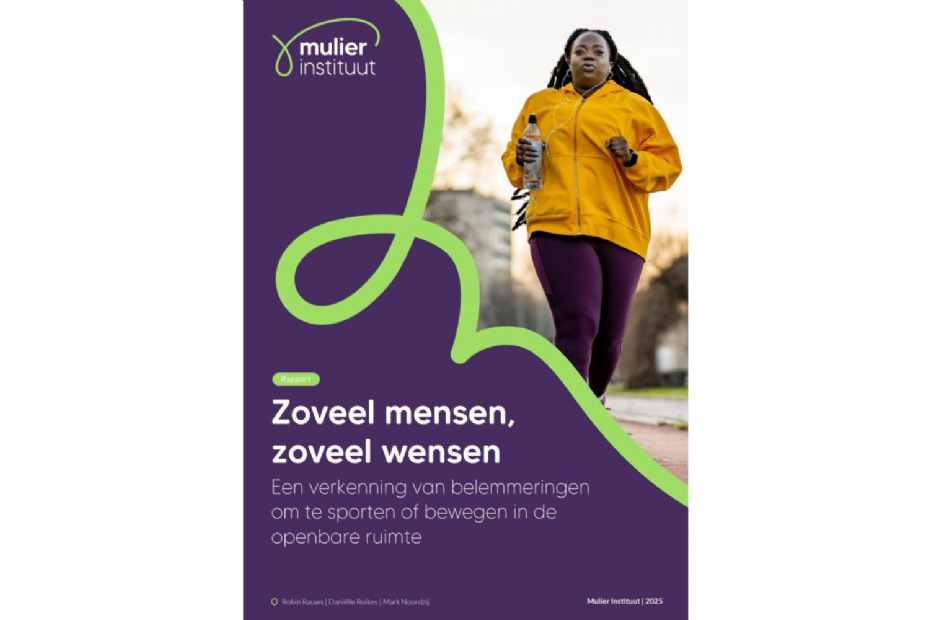 | | Cover of the Mulier Institute research report 'So many people, so many wishes' |
|
|
This article was previously published on December 15, 2025 on the Stad](https://www.stad-en-groen.nl/article/51919/van-obstakel-naar-ommetje-als-de-stoep-de-sportschool-is]Stad) + Groen website.
| LOG IN
with your email address to respond.
|
|
|
| There are no comments yet. |
|


