AI monitors and switches off the lights |
|
|
|
|
 |
| 194 sec |
Vlaardingen tests privacy-safe FieldWatch to manage sports fields
Football club CWO is located in a Vlaardingen neighbourhood where two artificial turf fields have deliberately been opened without fencing. This leads to much more use, but also fatbikes on the field, knocked-over goals and damage to the artificial turf. Volunteers increasingly feel unsafe and the municipality lacks hard data to determine whether keeping the fields open is still responsible. For that reason, the municipality started a pilot with FieldWatch, a fully GDPR-proof AI monitoring system.
| Football field with a FieldWatch pole |
'We simply want to know what is happening on our fields, but fully within privacy regulations,' says Stan Vrijenhoek, sports policy advisor in Vlaardingen. 'That is why we are renting FieldWatch for a year as a business case. The AI cameras anonymise everything directly on the hardware itself, allowing us to see exactly how the fields are used and loaded without privacy risks. Only then can we fairly assess what public sports fields deliver or cost us.'
From entertainment to management tool
'FieldWatch was originally an entertainment tool, designed to automatically recognise and record goals,' says Kor van der Bij, founder of FieldWatch. 'But soon it became clear, partly thanks to the expertise of Antea Sport, that sports clubs and municipalities mainly need insight into management, maintenance and protection.' The focus shifted to artificial turf management, preventing vandalism and improving field load distribution. Many clubs unknowingly use the main field much more intensively than fields two or three. 'If that load becomes visible through hard data and is linked to maintenance costs and lifespan, it changes the way clubs and municipalities look at their fields,' Van der Bij says.
Privacy-by-design
The FieldWatch camera system does not record identifiable persons. Images are blurred at the hardware level. A person on the field appears as an anonymised avatar. 'For gamers: think Minecraft characters. Identification or tracing back to individuals is impossible,' Van der Bij explains. This privacy-by-design approach is essential, partly because FieldWatch is partly publicly owned and works with European and provincial funding. According to Van der Bij, anonymity is the strength of the system: 'Despite full GDPR compliance, FieldWatch can collect detailed and reliable data on usage, load and vandalism.'
This anonymity does bring some limitations, but these hardly reduce the system's value. 'We find it more important to prevent damage than to know who caused it,' says Van der Bij.
|
|
'A person on the field appears as an anonymised avatar'
| |
|
What the system measures
FieldWatch combines real-time observations with technical field specifications, such as usage standards and expected lifespan. The system provides insight into:
* field load and occupancy,
* uneven use of parts of the field, for example the same half or the same goal being used repeatedly,
* effects on lifespan and maintenance costs,
* anomalies, such as fatbikes on the field.
Based on this data, the system generates graphs and forecasts, including an estimate of the remaining lifespan of the top layer. Municipalities can see whether a field needs replacement earlier than planned.
An important component is the connection with the field lighting. FieldWatch detects whether lighting is unnecessarily switched on and automatically sends notifications about this, Van der Bij explains: 'The system can also distinguish between training sessions, matches and informal use and adjusts the light intensity accordingly.'
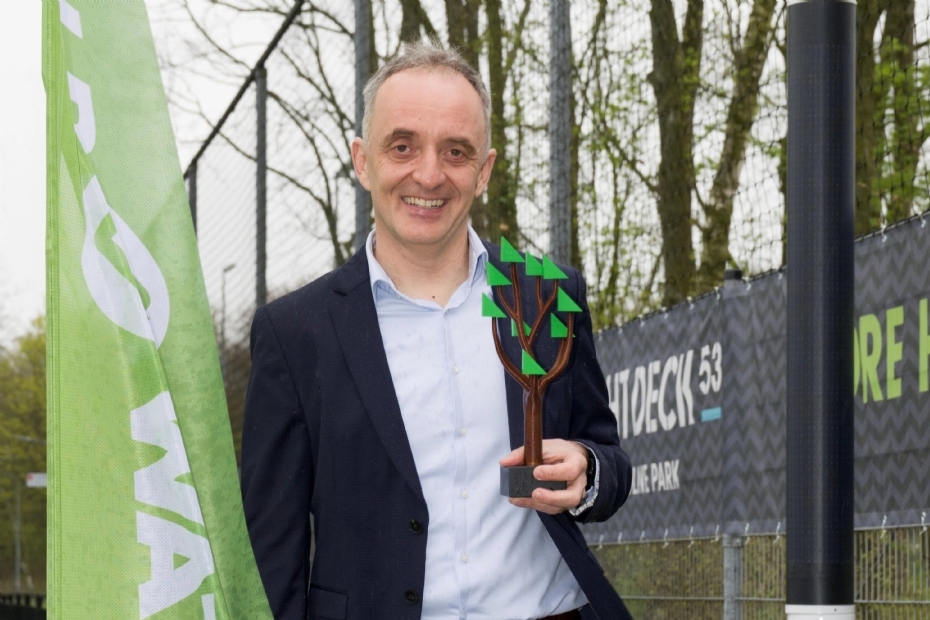 | | Kor van der Bij |
|
|
 | | Stan Vrijenhoek |
|
|
'No idea what is happening on those fields'
The immediate reason for Vlaardingen to test FieldWatch lies in the Open Sports Fields project. In this project, several artificial turf fields were deliberately opened without fencing to encourage sports and physical activity in the neighbourhood. 'We think it works, although we have no idea what is happening on those fields,' says Vrijenhoek. 'Volunteers often do not dare to intervene in case of possible misuse, which is very understandable.'
Opening the fields led not only to extra use but also to vandalism, damage to the artificial turf and a growing sense of insecurity among volunteers. Every week the chairman of CWO sent the municipality photos of vandalism. At the same time, objective insight was lacking: the municipality mainly received reports of incidents, without structural data about usage and possible misuse.
Traditional cameras are not an option
'A traditional surveillance camera is not an option for us,' says Vrijenhoek. Due to GDPR regulations, the municipality cannot deploy regular camera surveillance at sports parks, aside from the high costs and management involved. As a manager, you want insight into usage, load and misuse without monitoring individuals. FieldWatch fills exactly that space, because besides being a camera system it is also a data-driven instrument for sports field management.
|
|
'Besides a camera system, FieldWatch is also a data-driven instrument'
| |
|
Promising pilots
Vlaardingen is investigating this year whether FieldWatch can pay for itself financially. The expectation is that the gains will come from a combination of improvements: less vandalism, more balanced field use, more targeted maintenance and lower lighting costs. 'Together, this could result in a payback period of three to five years,' says Van der Bij. 'After that, the system generates structural savings.'
'With this pilot we want to gain insight into whether FieldWatch can help keep the fields open, spread usage more evenly and organise maintenance more efficiently,' says Vrijenhoek. 'If that proves to be the case, we want to investigate whether we can implement this more broadly in Vlaardingen.'
At the same time, an AI pilot with six municipalities, including Den Bosch and Arnhem, is running in parallel. In the longer term, field lighting will also be fully automated via API connections. The lights will dim when a field becomes empty and match lighting will be activated when needed.
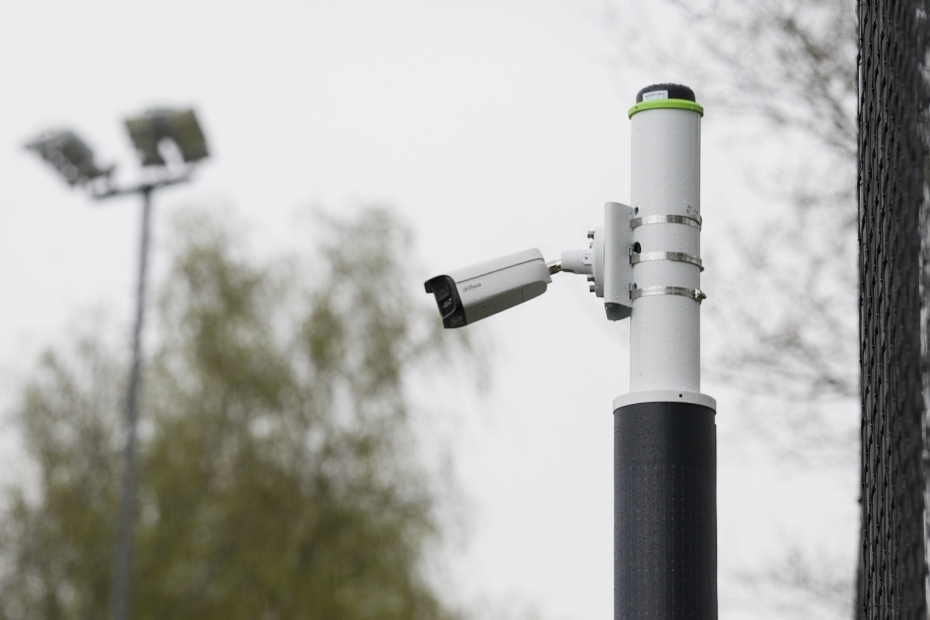 | | FieldWatch pole |
|
|
Inspiration session sustainable field management
On 28 May, the BSNC (Branch organisation for Sports and Cultural Technology) will organise a networking and inspiration session on sustainable field management. Participants will have the opportunity to experience FieldWatch technology in practice on the field itself.
|
This article was previously published on 2 March 2026 on the Fieldmanager](https://www.fieldmanager.nl/article/53013/ai-houdt-toezicht-en-doet-het-licht-uit]Fieldmanager) website.
| LOG IN
with your email address to respond.
|
|
|
| There are no comments yet. |
|
| |
Anyone can place small ads for free through their own account.
Place a free ad
|
|
|
|





