'The question is how to sustainably stabilise the rootzone with minimal disturbance' |
|
| GARDEN AND PARK TECHNOLOGY |
|
|
|
|
 |
| 161 sec |
Ruud de Deugd on the evolution of soil improvement
During a meeting for Belgian greenkeepers, Ruud de Deugd of VGR Equipment gave a presentation on a topic he believes is more fundamental than many golf courses realise: sand and air. Not at the surface, but deep in the rootzone. "Sustainable quality starts below ground," he explains. "Yet we still focus too much on what we see: speed, density, uniformity. But real stability is determined underneath."
| TopChanger enables sand injection using water pressure. |
In a conversation with trade magazine Greenkeeper, De Deugd explains why the traditional maintenance model is reaching its limits and why sand injection with water pressure is, in his view, becoming the new standard in modern greenkeeping. He is direct: anyone aiming for sustainable playing quality needs to work below ground. "The top layer gets a lot of attention, and rightly so. Topdressing, hollow tining, solid tining, linear aeration. These techniques are essential. They dilute organic matter, keep the upper centimetres open and improve surface structure." However, he stresses that many of these methods mainly affect the surface. "We apply sand in the top layer, but much less in the deeper rootzone. While that is exactly where oxygen availability and load-bearing capacity determine how strong and resilient turf can be."
Although these techniques remain valuable, De Deugd sees greenkeepers increasingly running into the same limitations. "Maintenance often follows a cycle. Compaction and organic build-up increase, problems become visible, then a major intervention follows. The issue is temporarily solved, but then it builds up again." According to him, this is not due to a lack of expertise. "It is in the system. Many interventions cause surface disturbance. That leads to pressure from members, reduced playability and less recovery time. As a result, maintenance is postponed until problems become acute. You are constantly working reactively."
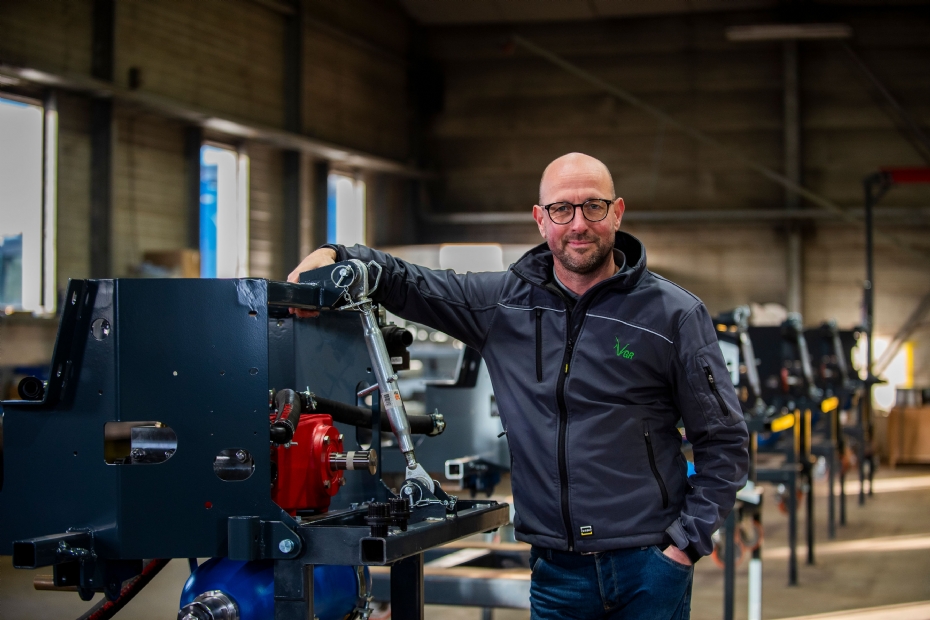 | | Ruud de Deugd |
|
|
Air
In addition, many interventions only create temporary pore space. "Hollow tines are not always fully filled. Solid tines create space but do not add supporting material. Grooves from linear machines often collapse again. You create air, but no lasting structure." According to De Deugd, greenkeepers need to focus more on macroporosity: the volume of large air-filled pores in the soil. "Under playing pressure and due to organic build-up, macroporosity decreases. Soil density increases and air becomes the limiting factor." Air is crucial for healthy roots. "Oxygen moves ten thousand times slower through water than through air. If a profile saturates quickly and drains poorly, insufficient oxygen reaches the roots. Plants always respond the same way: shallower rooting, higher stress sensitivity, less resilience during drought and heat." He summarises it in one sentence: "What you see above is determined below."
Sand injection with water pressure
De Deugd sees sand injection with water pressure as a logical next step in maintenance. "Instead of creating temporary air channels, this technique places sand deep into the profile. Water is injected under controlled pressure. It finds its way through the existing pore structure. The sand carried with it is deposited at that depth. When the pressure drops, the soil closes again, but now around sand instead of air." The result is not collapsing air channels, but a stable sand structure that supports macroporosity in the long term. Machines such as the TopChanger combine aeration with water-based sand injection. "This allows you to actively integrate sand where needed with minimal surface disturbance," says De Deugd.
|
|
"Two to five centimetres of extra effective root depth can make the difference between stress and stability during warm or dry periods"
| |
|
According to De Deugd, the main gains lie in three aspects. First, sand reaches deeper into the profile, stabilising the structure where roots struggle with oxygen and water. Second, surface disturbance remains limited. "You can apply it more frequently, as golfers hardly notice it." Third, preventive maintenance becomes realistic. "You no longer need to wait until problems arise." Greenkeepers working with cool-season grasses such as Agrostis stolonifera, Poa annua and Festuca species can expect deeper rooting. "That is where the real benefit lies. Two to five centimetres of extra effective root depth can make the difference between stress and stability during warm or dry periods." This marks a shift in mindset: from reactive maintenance to structural rootzone improvement.
Evolution
While De Deugd emphasises that traditional aeration and topdressing remain essential, he sees sand injection with water pressure as a logical progression. "It is not a replacement. It is the evolution of the profession, just like precision fertilisation and data-driven irrigation have become standard." According to him, the key question is changing. "We no longer need to discuss whether we should aerate. The question is how to sustainably stabilise the rootzone with minimal disturbance." He expects this approach to become standard within a few years. "Then we will look back and wonder why we ever did it differently."
This article was previously published on 13 April 2026 on the Greenkeeper](https://www.greenkeeper.nl/article/53603/de-vraag-is-hoe-we-de-wortelzone-duurzaam-stabiliseren-met-minimale-verstoring]Greenkeeper) website.
| LOG IN
with your email address to respond.
|
|
|
| There are no comments yet. |
|
| |
Anyone can place small ads for free through their own account.
Place a free ad
|
|
|
|





