From potato shed to millions of cuttings at FNK YoungPlants |
|
|
|
|
 |
| 152 sec |
How a practical approach, international experience and strong partnerships form the basis for growth
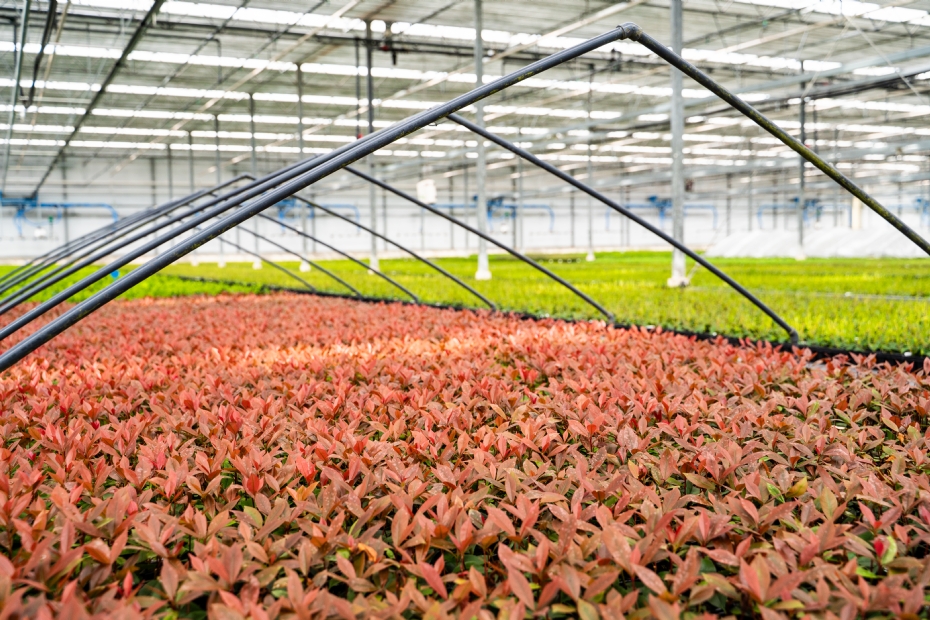
Anyone walking through the greenhouses of FNK YoungPlants today will see a tightly organised production of young plants. But the company of Rick Kolster, with two locations in Kudelstaart and Nieuwveen, started much more simply: in an old potato shed, with trading activities and a strong dose of perseverance.
Kolster showed an entrepreneurial mindset at an early age. During his studies in Zwolle, he started a cut shrub nursery with a classmate. After graduating, he moved to England to work at a nursery in Lincolnshire. "It was the most boring and flat part of England," Kolster recalls with a smile. "But I did learn how the English market works, how growers operate and how their mindset differs. We Dutch think that if we speak English, we also think English, but they really think differently."
From trading to own production
Back in the Netherlands, he briefly worked at a temp agency for a grower. During that period, Kolster became clear about how he did not want to run a business. "At that time, foreign workers were sometimes treated quite poorly. I learned how that world worked, but I didn't want to do it that way." Together with his father, he started FNK YoungPlants in 2007. Initially as a trading company: buying and reselling cuttings from an old shed, mainly to foreign customers. "We basically started with nothing," Kolster says. "In an old potato shed, collecting and trading plants for English, German and some Dutch clients."
Soon, the company moved to an empty greenhouse for trading. There, they started with their first table of their own cuttings, much to the enthusiasm of Kolster senior. "My father already had a lot of experience in propagation, that was his passion. So we started producing part of the material ourselves."
 | | No caption |
|
|
As said, so done
Growth followed quickly. The first location soon reached capacity, making expansion necessary. Kolster looked for additional space, especially to produce more cuttings in winter. That proved difficult, as suitable space in the area was scarce. Through contacts, he met a grower who suggested a different solution. "Maybe you should just buy a greenhouse," Kolster recalls. "I needed it, but I didn't have the money. It wasn't just about buying it, but also pre-financing the crop and labour. Then he said: calculate what you need, and we'll arrange it. As said, so done."
Not long after, uncertainty hit at the start of the COVID-19 pandemic. Orders dropped and tension increased as cancellations followed one after another. "That wasn't very pleasant," Kolster summarises. Soon after, the market turned completely and demand for young plants increased rapidly. Within a short time, the company was running at full capacity again, and the expansion proved to be well timed.
|
|
"All customers have their own requirements, and we keep them all separate."
| |
|
The customer comes first
Today, FNK YoungPlants works with around six permanent employees and a flexible workforce. Each year, they produce millions of cuttings. The organisation is clear, but operations are complex. For one plant species, multiple variants are often produced, depending on customer requirements. Sometimes, one plant is supplied in four different quality stages. "One customer wants freshly rooted material, another wants a more developed plant. Another prefers overwintered material. Each has their own demands, and we keep them all separate."
This requires overview and knowledge of customers. Many processes are still managed in the heads of Kolster and his team, but a new software system should help to better record all information. Around 40 percent of production is exported. The main markets are England, Poland and Germany. The company also supplies customers outside Europe, including Japan and South Korea. Still, Europe remains the main market due to short supply chains and the ability to respond quickly.
Cooperation in the chain
A significant part of the assortment consists of varieties from Plantipp. The partnership dates back to when FNK YoungPlants started its own production. Over the years, the relationship has developed into close day-to-day cooperation. "They think along with us and are transparent. Everyone needs to earn something, but it has to remain fair."
According to Kolster, the company's strength lies in climbing plants. He highlights Clematis 'Taiga' as a favourite due to its unique flowering period. Trachelospermum jasminoides 'Star of Toscane' is also worth mentioning. "It's a very strong Tuscan jasmine," Kolster explains. "Yellow is not the most popular colour, but it remains a good seller. It offers something different from the standard white and is simply a strong, healthy grower."
This article was previously published on 28 April 2026 on the Boom
In Business website.
| LOG IN
with your email address to respond.
|
|
|
| There are no comments yet. |
|
| |
Anyone can place small ads for free through their own account.
Place a free ad
|
|
|
|





