The future of cultivation lies in the root environment |
|
|
|
|
 |
| 215 sec |
What aubergine grower Peter Boekestijn can teach tree nurseries about water, roots and resilient crops
Anyone who wants to understand where tree nurseries are heading in the coming years should not only look at fellow growers, but also spend time in greenhouse horticulture. Growers there have been ahead for years in water use, recirculation, biological control and resilient growing systems. Many developments that start there later find their way into tree nurseries. This now also applies to how growers deal with water, the root environment and biostimulants.
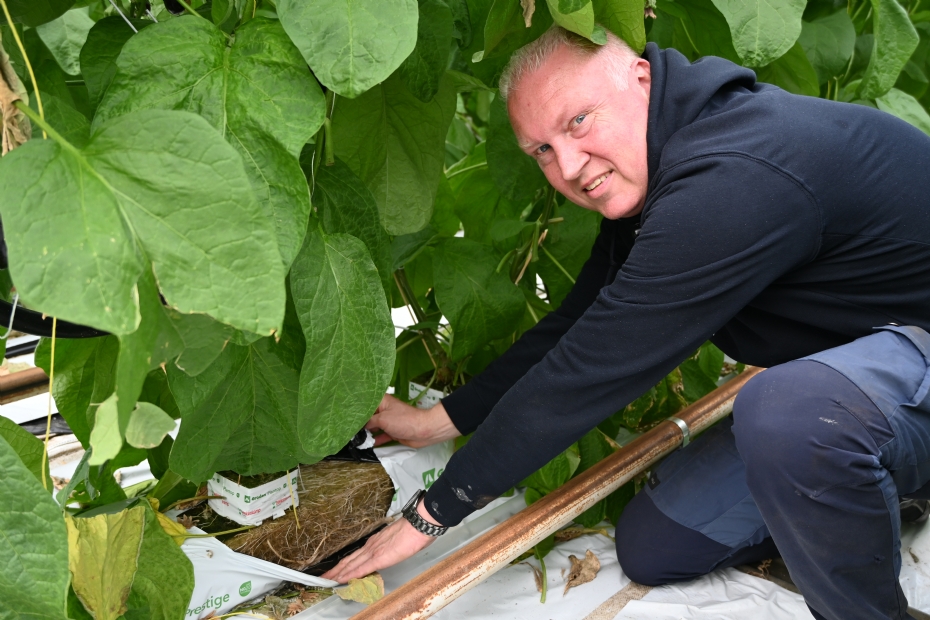 |
At aubergine nursery Van Onselen in De Lier, Peter Boekestijn has been working with the same crop for decades. He knows the plant, its growth and root behaviour in detail. His starting point is simple: in the end, yield and quality matter. Everything he does is aimed at production, uniformity and continuity. That is why it is notable that the company has started experimenting at one location with a different approach to water and the root environment: preventive and biological instead of curative and chemical. "I don't quickly believe in something," Boekestijn says. "You need to see your approach reflected in the crop. In the end, it's about what you produce in kilos. That's what everything is judged on."
This touches on the core of the story. New techniques and biostimulants are only relevant if they contribute to production, reduce risks or stabilise cultivation.
Clean water is the basis
One of the main topics at the company is water. In greenhouse horticulture, water is no longer just a transport medium for fertilisers, but an integral part of cultivation. Water leaving the greenhouse is collected, filtered and reused. At Van Onselen, the water first passes through a cloth filter before returning to the silo. This removes dirt, organic material and sludge. While this may sound technical, Boekestijn sees it primarily as a cultivation issue.
|
|
"Clean water, and especially oxygen-rich water, is the basis. If your water quality is not right, you can do everything well above ground, but problems will remain."
| |
|
This way of thinking is also relevant for tree nurseries. Especially in container cultivation and recirculation systems, water circulates multiple times and can carry problems along with it. Issues often start in the root environment, while negative effects above ground only become visible later.
From sterile cultivation to biological balance
For many years, greenhouse growers used products such as hydrogen peroxide to keep pipes clean and reduce bacteria in the water. The idea was clear: fewer bacteria and fungi in the system would lead to fewer problems in the root environment.
In recent years, this view has shifted. More growers realise that a completely sterile system can also have disadvantages. If unwanted bacteria or fungi enter the substrate later, they can develop quickly because there is no biological balance. "If you make everything sterile, you also remove resistance," says Boekestijn. "Then you are balancing on a knife edge."
He also questions the impact of strong disinfectants on fine roots. Damage to these roots can cause plant stress and trigger new root growth, making the plant more vegetative and potentially affecting the balance between growth and production.
As a result, the focus is shifting from sterile cultivation to building a resilient root environment with biological balance. Instead of reacting to problems, the aim is to prevent them.
Working with AB Products as part of the cultivation system
At one location, the company works with a Skal-registered product range from AB Products. This is not about a single product, but a combination aimed at water quality, root development, plant vitality and production. For the water system, AB AquaFoam and AB DripFoam are used. AquaFoam works with beneficial bacteria that absorb available nutrients in basins and silos, reducing the chance for algae and unwanted micro-organisms. DripFoam is used to clean pipes and drip systems, preventing biofilm and blockages.
During cultivation, several biostimulants and fertilisers are also applied. AB Orga Crop is used to strengthen leaves and plants and improve vitality and resilience. AB Sea Elixer is applied as a biological liquid fertiliser for growth and flowering. For flower and fruit quality, AB Osabio-S is used, a water-soluble foliar fertiliser that supports nutrient uptake and biomass development.
A key point is that these products are applied from the start of cultivation, not only when problems arise. "I want a population of beneficial bacteria in the slab before harmful ones arrive. So we start using these products when the slab is first filled. That way, you build a biological balance from the beginning." For Boekestijn, it is not about one product, but the entire system around water, roots and plant resilience.
Calm roots instead of many roots
During the greenhouse tour, Boekestijn points to the roots in the substrate. He looks not only at the quantity, but especially at the type of root system. "You don't want excessive root growth. You want calm roots. If roots are damaged, the plant produces new roots and becomes more vegetative. That leads to more leaves and growth, but not necessarily more production."
This principle is also relevant for tree nurseries. Many growth problems, poor ripening or uneven batches do not start above ground, but in the root environment. Water quality, oxygen levels in the substrate and biological balance around the roots ultimately determine how a plant grows and how resilient it is. In that sense, good cultivation starts not with fertilisation or crop protection, but with water and roots.
Experiment and keep developing
According to Boekestijn, one of the most important factors is that growers continue to experiment and try new approaches. Greenhouse horticulture has developed through continuous innovation and the search for better cultivation methods. Innovations often start there and later spread to other sectors, including tree nurseries.
At his own company, changes are not implemented all at once, but tested on a limited scale first. On a 4.5-hectare site, the system focusing on water quality, biostimulants and resilience is applied, while the rest of the company continues with conventional systems. This limits risks and allows for a return to the previous approach if needed. "We thought it through carefully before starting," says Boekestijn. "But the risks are limited. If it doesn't work, you can always go back to your proven system. So why not try?"
According to him, this may be the key lesson for growers, regardless of the sector they work in.
|
|
"I would like to say to everyone: try something. One does this, another does that. But if no one tries anything, we won't move forward."
| |
|
This article was previously published on 29 April 2026 on the Boom In Business website.
| LOG IN
with your email address to respond.
|
|
|
| There are no comments yet. |
|
| |
Anyone can place small ads for free through their own account.
Place a free ad
|
|
|
|





