Water management without pipes, pumps or electricity: is it possible? |
|
| GARDEN AND PARK TECHNOLOGY |
|
|
|
|
 |
| 140 sec |
Belgian installer Greenmix introduces GEPS system for golf courses and green space management
Removing water is not the problem, says Dewi Merckx of Greenmix. According to him, water management is about restoring the natural movement of water through the soil. The GEPS system from the American company Exlterra uses vertical polyethylene profiles installed in the ground to achieve this.
| GEPS units are installed in the ground after holes have been drilled with a diameter similar to that of a hole cutter |
These vertical profiles are said to make small movements under the influence of water pressure, creating space for both water infiltration and drainage. The system is already being used on several European golf courses, including Royal Antwerp Golf Club. But what exactly happens below ground level? And how does this technology compare with existing solutions such as drainage systems? 'The biggest mistake people make is comparing GEPS to drainage,' Merckx said during an interview conducted via Teams. According to him, the system was developed to influence soil structure in such a way that water can move more easily through the soil profile.
 | | Dewi Merckx, Greenmix |
|
|
Pressure
According to Exlterra, GEPS is based on well-established soil science principles, including capillary action, pressure differentials within the soil, and the movement of water between different soil layers. The company states that the flexible profiles create additional pore spaces and localized pressure gradients in the surrounding soil. These processes are said to help water move more easily across barriers between different soil types. The result, according to Exlterra, is improved infiltration and a more even distribution of moisture throughout the soil profile. The mechanisms described are outlined in a technical report produced by Exlterra itself; independent scientific verification of the system's performance under practical field conditions appears to remain limited.
How it works
According to Exlterra, a GEPS profile influences not only the soil at the installation point, but also the surrounding area. The system is said to facilitate water movement through the soil. The manufacturer also claims that GEPS creates pressure differences at the transition between different soil layers. This would allow water to pass more easily through barriers between sand, loam and clay layers. Local infiltration rates are also said to increase. According to Exlterra, rainwater can therefore be absorbed more quickly into the soil without the need for additional materials. In this context, Exlterra refers to a so-called 'volume of influence': the area around a GEPS profile where these effects would be noticeable. The size of this influence zone depends on the length of the installed profile and local soil conditions.
Ground Energy Passive System
GEPS stands for Ground Energy Passive System. The system consists of vertical polyethylene units or profiles installed in drilled holes ranging from 1.5 to 12 metres deep. According to Merckx, these units respond to pressure that develops when water accumulates in the soil. Small movements of the profiles are said to create space around the material, allowing water to move more freely. According to Merckx, a single unit can facilitate the infiltration of around 200 litres of water per hour. He notes that the theoretical capacity is much higher, but that 200 litres per hour represents a conservative estimate with a substantial safety margin.
|
|
The system does not transport water; it creates space.
| |
|
Not drainage
According to Merckx, this is the key difference compared with drainage systems. 'The goal of GEPS is not to move water downwards. The goal is to create space. Once that space exists, water can naturally distribute itself through the soil profile.' According to Greenmix, the technology is currently being used on six golf courses across Europe. One of the best-known projects is Royal Antwerp Golf Club, where nearly ten kilometres of GEPS profiles were installed across nine holes between late 2024 and early 2025. The project was prompted by severe waterlogging following prolonged periods of rainfall in late 2024.
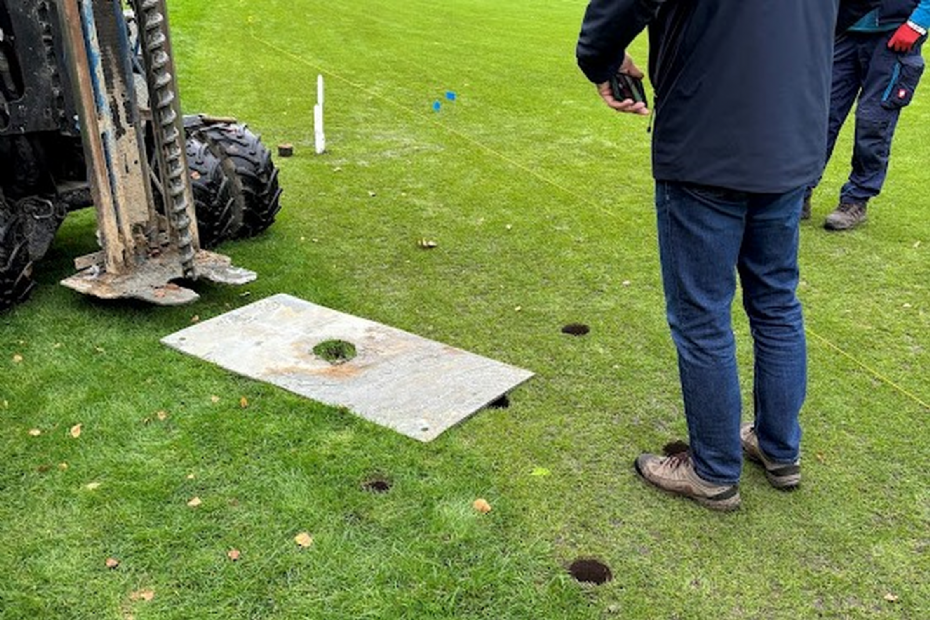 | | Installation at Royal Antwerp |
|
|
Critical questions
During the preparation of this article, the editorial team asked Exlterra for independent scientific research supporting the physical operating principles of the GEPS system. Following an online search, no such research appears to be available. Dewi Merckx was also unaware of any independent studies, and no supporting research was provided by Exlterra. The company's website contains limited information about the physical mechanisms behind the claimed improvements in water transport and soil structure.
This article was previously published on 10 June 2026 on the Greenkeeper](https://www.greenkeeper.nl/article/54395/waterbeheer-zonder-leidingen-pompen-of-stroom-kan-dat]Greenkeeper) website.
| LOG IN
with your email address to respond.
|
|
|
| There are no comments yet. |
|
| |
Anyone can place small ads for free through their own account.
Place a free ad
|
|
|
|





