| Jan Willem de Groot, Terra Nostra,
Friday 21 August 2026 |
 |
| 212 sec |
A different way of looking at old trees
This week I received the sad news that Neville Fay has passed away. Although I knew he was seriously ill, the news still came as a shock.
| Photo: Marek Zarankiewicz |
With Neville, the international tree care community loses an exceptional professional, thinker and source of inspiration. He made an important contribution to the way we look at ancient and veteran trees. For those who worked with him, he was also someone who made a lasting impression through his curiosity, commitment and open-minded approach.
I personally got to know Neville through our collaboration on Trees - A Lifespan Approach. Together with Neville Fay, Nigel de Berker, Dirk Dujesiefken, Kamil Witkos-Gnach and Piotr Tyszko-Chmielowiec, I had the special opportunity to reflect from different European professional perspectives on a central question: how should we care for trees when we truly take their entire lifespan as our starting point?
The book therefore became much more than a description of young, mature and old trees. It became a shared exploration of how trees develop, adapt, become damaged, recover and rebuild structure over decades and sometimes centuries.
Neville was the one who consistently brought the perspective of old and veteran trees into this discussion. The processes visible in these trees can also tell us much about how we should guide trees in earlier stages of their lives.
That way of thinking has permanently influenced my own view of trees. It has made me realise more clearly that good tree management does not begin with intervention, but with observing, understanding and respecting what a tree has already built up during its long life.
Veteran trees and conservation arboriculture
Neville made an international contribution to the way we view monumental, ancient and veteran trees. In a field that was long dominated by concepts such as safety, defects, decay and remaining life expectancy, he was among those who introduced a different perspective.
An old tree with cavities, dead wood, fractures, fungi and a declining crown is not automatically a tree that has reached the end of its life. These characteristics can actually be the result of an exceptionally long life history.
Such a tree has endured storms, drought, injuries, decay and changes in its surroundings, adapting again and again. Cavities, dead wood and decomposition processes are not merely defects. They can be part of the tree's survival strategy and are at the same time of great importance for biodiversity.
Neville helped broaden the field towards conservation arboriculture: an approach in which lifespan, ecology, cultural history, soil, risk and natural processes are considered together. His work for organisations such as the Ancient Tree Forum and his contribution to methods for assessing and managing veteran trees have had a major influence on tree managers and tree specialists far beyond the United Kingdom.
Ancient trees, ancient soils
An important part of Neville's thinking was his attention to ancient soils: old soils that, like old trees, carry a long history within them. When we look at an ancient tree, we mainly see what is above ground: the trunk, crown, cavities, dead wood, wound responses and new reiterations. But beneath that tree there is also a history that has developed over a very long period of time.
Neville emphasised that an ancient tree and its soil can hardly be considered separately. Roots, fungi, microorganisms, soil fauna and organic matter together form a complex ecosystem that may have developed over many generations. This leads to an important consequence for our profession: anyone who wants to protect a monumental or veteran tree cannot stop at the base of the trunk. The soil, root environment, soil life and continuity of the growing site are also part of what deserves protection.
This insight may now seem more obvious than it did several decades ago. The fact that it is now so widely recognised in the management of ancient trees is partly thanks to people like Neville.
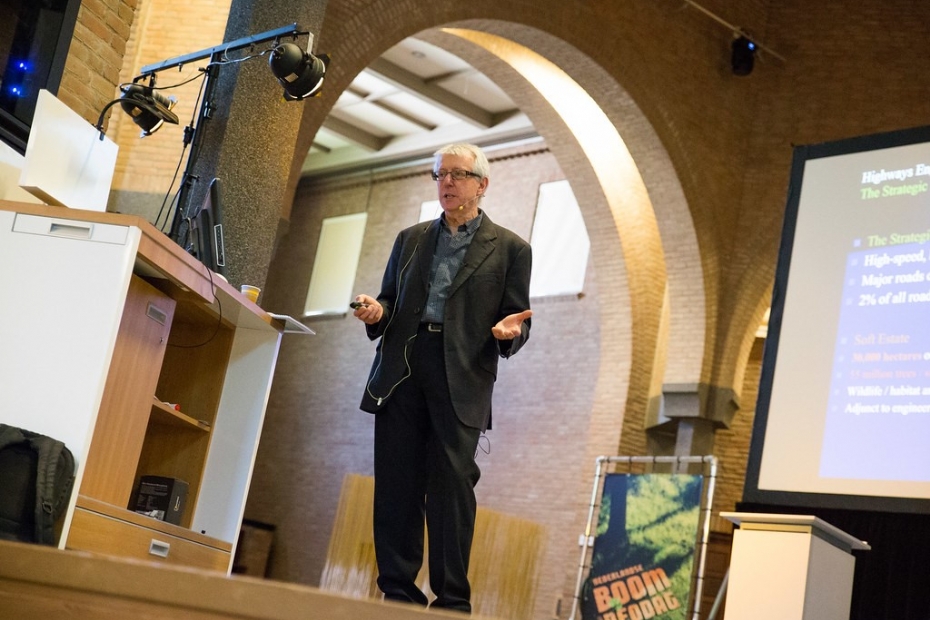 | | Neville Fay during the Dutch Tree Information Day on 9 June 2016 in Velp |
|
|
Neville at the Dutch Tree Information Day
Neville also shared his knowledge and vision directly with the professional community in the Netherlands. During the Dutch Tree Information Day on 9 June 2016 in Velp, he spoke about veteran trees and conservation arboriculture. What stayed with me from that presentation was the openness with which he not only explained what he considered good management, but also discussed situations in which earlier management measures had given him new insights.
One of his examples concerned ancient oaks where well-intentioned interventions in the immediate surroundings ultimately proved more intrusive than expected.
The lesson he drew from this was typical of Neville: be careful with the human tendency to want to improve an ancient tree. A tree that has survived for hundreds of years functions according to processes and timescales that we can never fully understand. Well-intended intervention can disturb a balance that has developed over a very long period.
This also reflected a certain humility: first observe, then try to understand, disturb as little as possible and only then determine which interventions are truly necessary.
A different way of looking
Perhaps this is ultimately Neville's greatest legacy. He gave the profession not only knowledge, but above all a different way of looking at old trees. Not only at the tree as an individual organism, but at the tree as part of a much larger and often centuries-old ecosystem.
My own collaboration with Neville on Trees - A Lifespan Approach makes his passing personal as well. I look back with great appreciation on our conversations, discussions and meetings. Neville was not only a passionate professional, but also a warm and committed person. The fact that our names appear together on Trees - A Lifespan Approach now carries a special meaning.
Neville leaves behind much: publications, methods, organisations and ideas. But above all, he leaves behind a profession that has learned to look differently at old trees partly because of him.
His most important legacy may not be written on paper; it stands outside. In the ancient trees that were not removed because people learned to see them differently. In veteran trees that were given space to continue ageing. In cavities and dead wood where life was able to continue. And in ancient soils that were left undisturbed because someone understood that an irreplaceable history exists beneath the ground as well. That is a legacy that will continue for a very long time.
Thank you, Neville, for your knowledge, your inspiration and your contribution to our profession. Rest in peace, Nev.
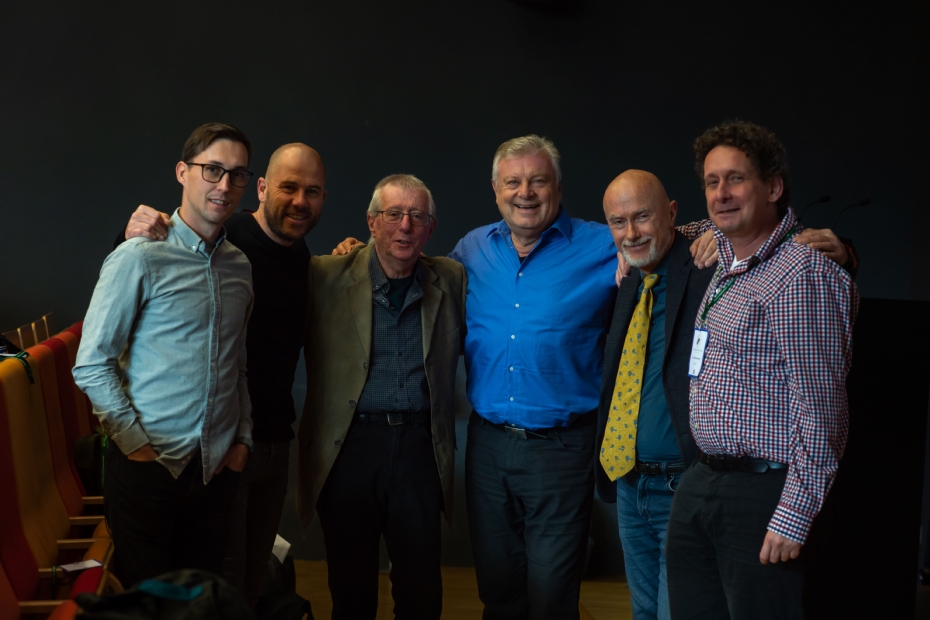 | | From left to right: Kamil Witkos-Gnach, Jan Willem de Groot, Neville Fay, Dirk Dujesiefken, and Piotr Tyszko-Chmielowiec during a congress in 2022 in Wroclaw, Poland. Photo: Marek Zarankiewicz |
|
|
This article was previously published on 21 August 2026 on the website of Boomzorg.
| LOG IN
with your email address to respond.
|
|
|
| There are no comments yet. |
 |
| Dit is een premium artikel |
Artikelen op de NWST sites zijn gratis en zullen altijd gratis blijven.
Voor de meest recente artikelen heb je een account nodig om verder te lezen.
Klik hier om te registeren of in te loggen.
|
|
| |
Anyone can place small ads for free through their own account.
Place a free ad
|
|
|
|





