Green roof, dry summer: what about fire safety? |
|
|
|
|
 |
| 197 sec |
Fire safety changes with moisture levels, vegetation and maintenance
Green roofs and facades help with rainwater retention, cooling and biodiversity. But vegetation is living material and changes with the weather and maintenance. What does this mean for fire safety during a long, dry summer? A small fire on the grass roof of the TU Delft Library has brought this question into focus. Research into green facades also shows that moisture content, system design and maintenance influence fire behaviour.
| This roof is an example of a project under construction during drought. The irrigation system has not yet been connected. The roof is intended to be green, but drought can give it a reddish appearance. |
On 10 August, a fire broke out in a strip of grass at the top of the sloping roof of the TU Delft Library. A student spotted the flames and raised the alarm. The fire was quickly extinguished. A discarded cigarette butt, combined with dry conditions, may have caused the fire.
The roof was already watered daily, but some areas remained dry. The sprinklers did not cover every area equally. Grass at the top of the roof was drier and more yellow than at the bottom because water runs downhill. Following the fire, the university decided to review its sprinkler procedures.
|
|
A green roof can look very different in August than in April
| |
|
Living vegetation is not like bricks or roof tiles
A brick or roof tile remains largely unchanged. A plant does not. It grows and flowers, but it can also dry out or die during a long dry period. Moisture content affects fire behaviour. During fire tests on a prototype green facade, severely dried plants caught fire quickly. Flames then spread horizontally through the vegetation.
With healthy, moist plants, the fire developed differently. The plastic facade system caught fire first, followed by the plants. These tests involved green facades, so the results cannot be directly applied to the green roof in Delft. However, they show that the condition of vegetation can make a difference.
|
|
'The foundations of fire safety are laid during the design stage'
| |
|
Not all green facades are the same
A green facade involves more than plants. Planters, fixings and other components can also influence fire behaviour. A living facade changes continuously as plants grow and dead leaves or pruning waste accumulate.
Conditions during fire testing also matter. Is the vegetation moist? Is the irrigation system filled? And does the tested system match the final installation?
According to Gerro van de Meent, Green Roof and Facade Manager at Wallaard Groen, fire safety begins well before planting. 'It starts at the design stage and requires an integrated approach to the entire roof structure, construction details, surroundings and maintenance. You cannot consider these aspects separately.'
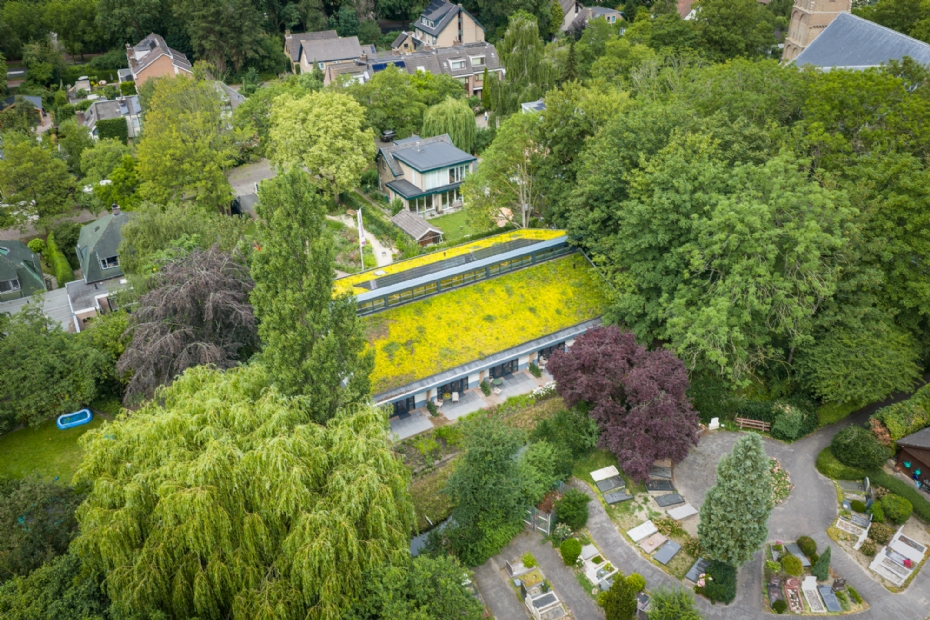 | | This roof in Pijnacker shows how a sloping green roof looks when it receives enough water and the vegetation is in full bloom |
|
|
When constructing green roofs, Wallaard follows the VBB-FLL guidelines for design, installation and maintenance. The company also holds Groenkeur certification for Green Roofs and Facades. These guidelines and standards provide an important basis for technical design and construction. Wallaard also follows applicable Dutch regulations and NTA 8292:2016, including requirements for wind resistance and fire safety.
Van de Meent explains: 'It is about the entire system, from substrate to vegetation. Around vertical structures and roof edges, you maintain a clear, non-combustible zone using gravel or paving slabs. This means safety is included in the design from the beginning.'
He emphasises the importance of involving green roof contractors early in the design process. 'Sloping green roofs are still relatively new. They are sometimes seen mainly as an innovative or attractive feature. As a result, they may be added late in the design process or even after construction has started. Finding a suitable solution then requires technical knowledge, flexibility and careful planning. The solution must be practical to install and comply with construction rules and guidelines.'
Watering is only part of the story
In addition to the roof structure, drying out plays an important role, just as it does in nature during drought. Wallaard uses drip irrigation on sloping sedum roofs, mainly to prevent vegetation from drying out rather than for fire safety. 'The system is primarily installed to prevent the vegetation from drying out. The fact that moisture also benefits fire safety is an additional advantage.'
The roof structure also determines how much water remains available. A blue-green roof can retain water in storage elements. These are mainly intended for rainwater retention, but they also keep water available to plants for longer.
 | | Gerro van de Meent |
|
|
Then the maintenance begins
A roof that meets all technical requirements when completed will not automatically remain in the same condition years later. Van de Meent recently encountered an example. 'We installed a beautiful sedum roof in spring, but maintenance was not our responsibility. The client forgot to switch on the irrigation system. After the dry period, the roof looked considerably worse.'
How quickly a roof dries out depends on several factors. 'The roof structure, vegetation, location and available water all play a role. Irrigation is particularly important during prolonged drought on sloping and sunny roofs.'
Sedum is relatively resilient. 'Sedum can withstand drought well, but only up to a point. During dry periods, you need to make sure the irrigation system works properly. On a sloping roof, that might mean supplying water through drip irrigation twice a day.'
|
|
'Sedum can withstand a lot, but only up to a point'
| |
|
Safety does not end when construction is complete
Once a project is completed, responsibility for maintenance ultimately lies with the client or end user. Wallaard therefore advises clients to include maintenance in their plans and can provide this service. 'You can deliver a beautiful green roof, but it still needs proper maintenance afterwards. We want a project like that to look good ten years from now. It would be a shame to see a roof deteriorate because maintenance has been neglected.'
The fire in Delft does not prove that green roofs pose a major fire risk. However, it shows that fire safety does not end with design and installation. Vegetation changes with the seasons, weather and maintenance. During prolonged dry periods, a well-designed roof system, sufficient water and regular maintenance are therefore particularly important.
This article was previously published on 19 October 2026 on the website of Stad + Groen.
| Wallaard Groenvoorziening | |
| |
| LOG IN
with your email address to respond.
|
|
|
| There are no comments yet. |
|
| |
Anyone can place small ads for free through their own account.
Place a free ad
|
|
|
|


