Conifers as avenue trees: get used to it! |
|
|
|
|
 |
| 438 sec |
Use them in the warming city
The use of conifers as avenue and park trees is not part of our culture; broadleaved trees have traditionally defined the green landscape. That historic image is increasingly at odds with the climatic reality of today's cities. Get used to them and use them more often!
| Pollarded Metasequoia glyptostroboides |
At 'my' horticultural school in Frederiksoord, Mr Hettema more or less tried to beat the use of conifers out of us. If you drew a Thuja or Chamaecyparis during garden design classes, you could easily end up with a failing grade. Yet the Pinetum (conifer collection) at the same school contained some true gems. Fortunately, Hettema never succeeded in turning me away from conifers. In fact, as happens with some plants, I have come to appreciate them more and more over the years. Their value extends far beyond the two genera mentioned above, and that is where things become interesting. Exciting, even. As far as I am concerned, their applications go well beyond production forests, cemeteries or private gardens. Use them!
Urban environment
First of all, certain conifers are very capable of coping with the hotter conditions found in urban environments. This is increasingly important because of urban heat and climate change. Heatwaves are becoming longer, and dry periods follow one another more frequently, causing not only the growing site to dry out but also reducing air humidity. Meanwhile, growing spaces continue to shrink. At the same time, rainwater from short, heavy downpours often fails to reach the rooting zone and instead flows directly into the sewer system. Many traditional avenue tree species perform less well under these conditions. It is time to expand the range with conifers.
The term "conifer" is derived from the Latin words conus (cone) and ferre (to bear), literally meaning "cone bearer". The name refers to the often dry, cone-shaped fruits in which seeds mature, a characteristic of many species within this plant group, including spruces, pines and cypresses.
Evergreen
Many conifers are evergreen. Their needles and dense branch structures provide a large surface area on which particulate matter can settle throughout the year. This occurs through direct contact or through air currents that bring particles close to the leaf surface. Factors such as leaf shape, surface structure (hairs, grooves) and a large leaf area increase the efficiency of this filtering process.
Natural electrical charge differences in the atmosphere can induce a mirrored charge on tree surfaces. This electrical charge attracts charged fine-particle pollutants. During rainfall, the captured particles are washed from the foliage to the soil, where some eventually become incorporated into the soil system. Conifers also absorb gases such as nitrogen dioxide, sulphur dioxide and ozone. There are indications that electrical processes around trees may play an additional role, although research in this area is still largely experimental.
In practice, the local effect is what matters most. Directly around the planting, pollution reductions of ten to thirty percent have been observed.
In addition to these climatic and air-purifying functions, conifers provide ecological value. Their dense, year-round canopy makes them particularly suitable as habitat for species such as sparrow colonies. Larger conifers are also frequently used as roosting sites by owls and other birds of prey. The abundance of aphids and aphid eggs does not go unnoticed by urban birds, allowing these trees to contribute significantly to biodiversity.
Below is a non-exhaustive list of inspiring examples that can be found somewhere in the Netherlands as street trees. They are often planted in wider profiles but are sometimes even found in paved areas. I will limit myself to species suitable for use as avenue and park trees, because not all conifers are appropriate.
|
|
'Their dense, year-round canopy makes conifers particularly suitable for sparrow colonies, for example'
| |
|
Tsuga heterophylla
Tsuga heterophylla is a conifer with a refined appearance. Its soft, dark green needles and often slightly drooping leader create a layered, cloud-like character. In its native range along the west coast of North America, it can reach impressive heights, although it generally remains smaller in urban settings. The species performs best in sheltered locations with adequate soil moisture and tolerates partial shade well. In parks and larger green spaces, western hemlock can function as a shady background tree and an important refuge for birds. Simply use seed-grown specimens.
Thuja plicata
Thuja plicata has a very different appearance. It grows vigorously, with fresh green scale-like foliage and a dense crown that is naturally columnar to broadly conical. The leader always remains upright. Native to western North America, this species is remarkably tolerant of urban conditions. It can be used in avenues, park edges and buffer zones, provided there is sufficient growing space for it to develop into a mature tree. Given enough room, the lower branches spread outward and root around the original plant. This can be seen beautifully at Trompenburg Gardens & Arboretum and on many estates. Naturally, this does not occur if the tree is crown-raised.
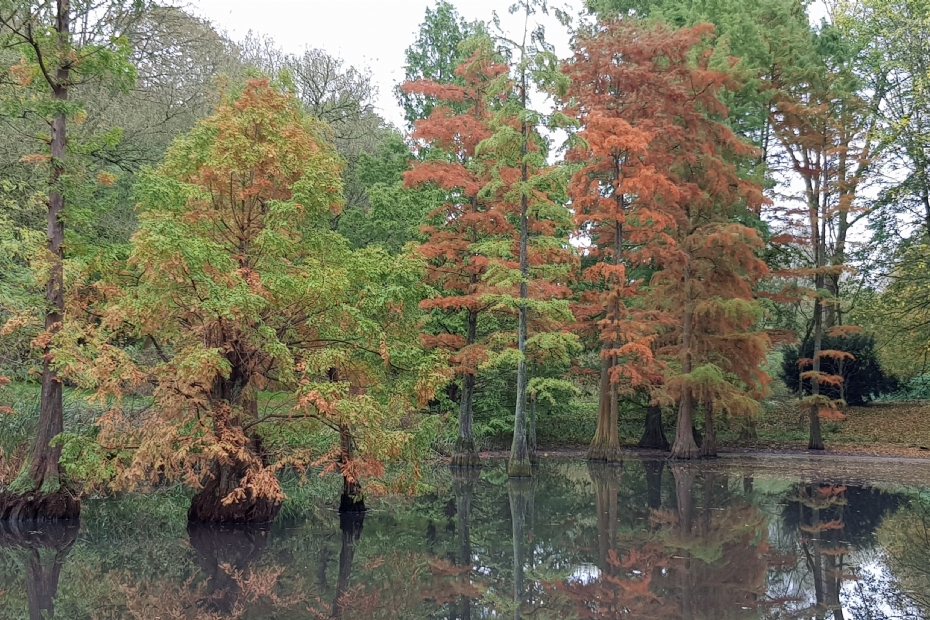 | | Taxodium distichum |
|
|
Taxodium distichum
Taxodium distichum differs from the classic image of a conifer because it sheds its needles. During the growing season, the foliage is light green and soft, turning a warm copper-brown in autumn. Native to wetland areas in the southeastern United States, it thrives in wet or periodically wet soils. It is particularly suitable for bioswales. It is not suitable for narrow planting profiles, partly because of its characteristic "knees" that emerge above ground level, but also because branch and stem failure are relatively common in older trees. As a result, mature specimens are often pollarded on a regular basis. Once you start doing that, however, you will need to continue indefinitely. A beautiful species, primarily suited to park settings. Dwarf and weeping forms are available.
|
|
'Want to make a statement? Then plant Sequoiadendron giganteum'
| |
|
Sequoiadendron giganteum
Sequoiadendron giganteum, together with Pseudotsuga, ranks among the largest trees in the Netherlands. With its blue-green needles and massive pyramidal crown, it demands both space and time. In the botanical world, Wellingtonia Avenue in Crowthorne, England, is well known. This long avenue was planted around 1860 in honour of the Duke of Wellington, best known for defeating Napoleon Bonaparte at Waterloo in 1815. Sequoiadendron was once known as Wellingtonia gigantea.
The Dutch Tree of the Year 2025 was the giant sequoia in Ledeboerpark in Enschede, although it is certainly not the largest specimen. If you want to make a statement, plant this tree. In young specimens, fungal infections can cause dieback of fine twigs, but this generally disappears as the tree matures.
Sequoia sempervirens
Sequoia sempervirens is slimmer and more elegant than the previous species. During the last century, we were taught that it lacked sufficient winter hardiness. Today, the oldest specimens are more than 70 years old. Its dark green, flat needles and tall, narrow growth habit give the tree a strong vertical character. In its native Californian coastal habitat, fog allows the stomata to absorb significant amounts of moisture, enabling trees to exceed 100 metres in height. Due to the absence of summer fog here, trees will never reach even half that size, although they remain highly impressive. Growth during the juvenile phase can be remarkable, reaching up to one and a half metres per year.
Pseudotsuga menziesii
Pseudotsuga menziesii is another very large tree. Its dark green needles, distinctive cones with protruding bracts and pointed buds make the species easy to recognise. Native to North America, it grows rapidly and develops a strong, wind-firm crown and a thick, attractively furrowed trunk. In parks, broad avenues and large-scale green spaces, it can serve as a robust structural tree, provided sufficient growing space is available. It does not tolerate waterlogged soils.
Pinus
Pinus sylvestris is, together with yew and juniper, one of the three conifers native to the Netherlands. Its blue-green needles and orange-brown upper bark give Scots pine a distinctive, sometimes rugged character. It tolerates poor and dry soils well and is suitable for open, sunny locations in parks and transitional zones, and even in heavily paved environments. Apeldoorn station square is a good example. Its relatively open crown structure allows light to penetrate and combines well with underplanting.
Pinus nigra
Recently, I have become uncertain about Pinus nigra, which is why it is not included here. In too many places I have seen major scaffold branches die back over recent years. Not because of light competition, but due to a cause that remains unclear to me. Is it drought? Heat stress from previous years? If anyone knows, I would be interested to hear.
Pinus pinaster has longer, darker green needles and a more irregular crown shape. Native to the Mediterranean region, maritime pine is well adapted to heat, drought and wind. Its long needles are distinctive. Although widely planted as a forest tree, it also performs well in urban environments. Do not plant it on wet soils.
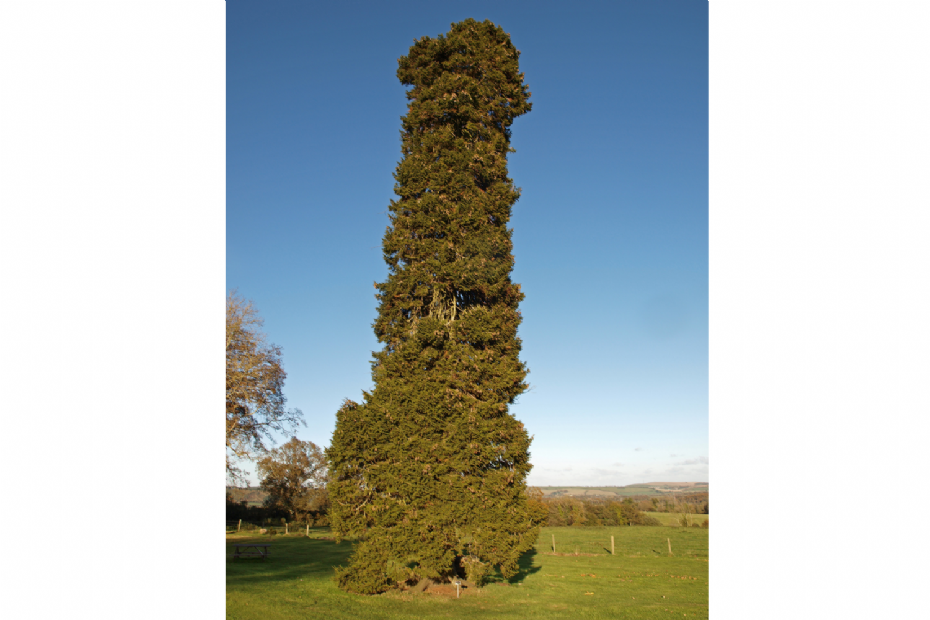 | | Picea orientalis |
|
|
Picea orientalis
Picea orientalis is a spruce with a fine, dense structure, short glossy dark green needles and a narrow crown. Native to the Caucasus and northeastern Turkey, it is a species of high ornamental value. Some cultivars produce striking yellow new growth that later turns dark green. Avoid planting on clay soils, but it performs well on normally moist to dry sites. Unlike Norway spruce, it has so far shown little susceptibility to bark beetle attacks, which have devastated many mature Norway spruce populations during dry summers.
Metasequoia glyptostroboides
Metasequoia glyptostroboides is a fast-growing deciduous conifer with a regular crown structure. Its light green needles turn a warm copper-brown in autumn. Native to China, it performs well on moist, fertile soils. One practical concern is that fallen needles can clog vehicle ventilation grilles, making the species unsuitable above parking spaces and in narrow streets. It can be pollarded regularly if required.
The earliest introductions following the discovery of this living fossil often developed deeply furrowed buttress bases. Later introductions tend to show much less pronounced ridging. Dwarf forms exist, as well as yellow-leaved and even variegated selections.
Cryptomeria japonica
Cryptomeria japonica is Japan's most important forestry tree. It naturally develops a strong central leader and is surprisingly wind-firm. On exposed sites, however, branches may break out. It grows well on all normally moist soils but dislikes stagnant groundwater. Simply select seed-grown specimens with a good crown structure. The well-known cultivar 'Cristata', with its fasciated growth, is more prone to breakage. The cultivar 'Lobbii' has a somewhat cloudier appearance but is also a good choice. Dwarf forms are less suitable for public spaces but work well in gardens. A highly underrated species.
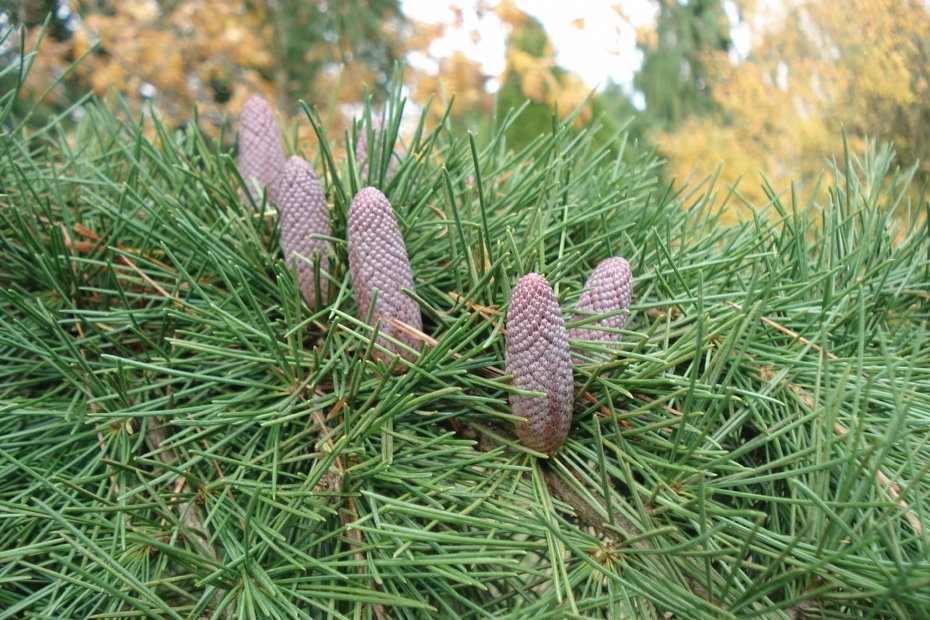 | | Flower of Cedrus deodara |
|
|
Cedrus
Cedrus deodara stands out because of its relatively long, soft needles and characteristic drooping branches and leader. Native to the Himalayas, it is highly tolerant of heat and drought. In warm urban parks and broad avenues, it can play a prominent visual role, provided sufficient space is available for its natural form to develop.
Cedrus atlantica
Cedrus atlantica has stiffer ascending branches and often blue needles, particularly in var. glauca. Native to North Africa, it is exceptionally well adapted to dry, warm conditions. In spacious urban settings, it can function as a robust avenue or park tree with strong landscape value.
Callocedrus decurrens
Callocedrus decurrens is a slender, upright conifer with dark green scale foliage. Native to California, it tolerates heat, drought and air pollution. This makes it particularly interesting for urban locations where height is desired but width is limited. It is highly stable and can therefore also be used in relatively narrow streets.
Abies
Abies nordmanniana is the familiar Christmas tree, with glossy dark green needles and a highly regular crown. Native to the Caucasus, it develops into a large tree. It can be used in parks and broad avenues with good soil quality, although it is less suitable for extreme drought conditions. Why not plant it somewhere where festive lights are hung every year?
Abies grandis
Abies grandis is a fast-growing fir that reaches enormous dimensions in its native western North American range. In the Netherlands, it is mainly used as a forestry tree. Its fresh green, flat needles and vigorous growth make it most suitable for large parks and landscape structures where space and long-term value are priorities. Crush the needles and enjoy the scent of oranges.
Abies concolor
I will conclude with Abies concolor. This white fir has striking blue-grey to silvery-green needles and a relatively open crown. Native to the southwestern United States, it has proven to be relatively tolerant of heat and drought compared with other Abies species. This makes it a promising choice for climate-resilient cities, provided the planting site is carefully designed.
Conifers are not only decorative; they offer considerable value as urban trees. We simply need to become more accustomed to them. They add useful species to the broad palette of trees available for cities facing a changing climate.
Planting early or late
Evergreen conifers should, of course, be planted with a good root ball. The most successful planting times are early (October) or late (March) in the planting season. Personally, I prefer transplanting in early October. At that time, roots can still develop in the relatively warm soil. This is important because needles and scales continue to transpire throughout winter. Especially in spring, a layer of Antivap is recommended. This natural wax forms a protective coating on and beneath the foliage, reducing transpiration. Antivap is applied to the leaves and buds using a backpack sprayer.
|
This article was previously published on 3 June 2026 on the Boomzorg website.
| LOG IN
with your email address to respond.
|
|
|
| There are no comments yet. |
|
| |
Anyone can place small ads for free through their own account.
Place a free ad
|
|
|
|





