J&E Sports calls for stricter requirements on dust formation in artificial turf projects |
|
|
|
|
 |
| 167 sec |
According to J&E Sports, quartz dust during the installation of artificial turf fields should be addressed much more explicitly at the source. Co-owners Ed Korstanje and John van Gennip have been advocating for years that sports sand should be supplied pre-moistened as standard, so that dust formation during processing is prevented as much as possible. However, according to them, this still happens too rarely. They also believe that price differences, tender procedures and varying working methods mean that safe processing remains under pressure in practice.
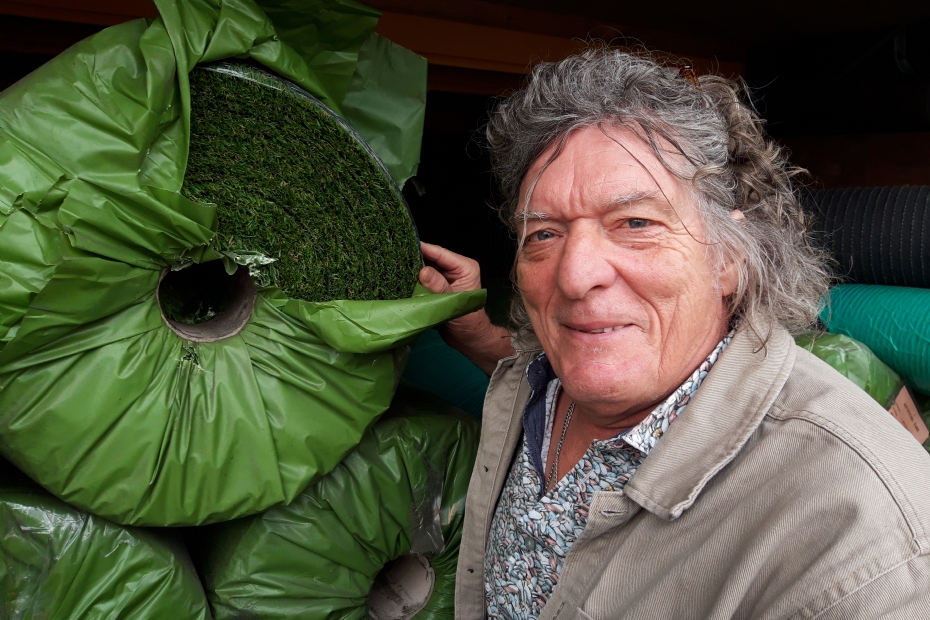 |
John van Gennip emphasises that quartz dust formation is not a theoretical discussion. 'Manufacturers sometimes refer to studies showing that the amount of respirable dust is limited. But respirable quartz dust is known to be harmful to health and is associated with lung diseases and lung cancer; you cannot downplay that. Our employees really do drive through substantial dust clouds.' His colleague Ed Korstanje explains what he regularly sees on projects. 'We have experienced situations where the sand creates so much dust that you can no longer see the spreader. Sometimes this happens right next to a canteen or after-school care facility. I have literally seen children stop playing outside because of the dust clouds. At that point, it is no longer just about our employees on the field, but also about the surrounding area.'
Moistening is crucial
According to Korstanje and Van Gennip, the sector has known for some time how dust formation can be reduced. Korstanje: 'Moistening prevents dust formation. With silos and bulk trucks, sand is often blown in dry from below. This causes small particles to break loose from the sand grains, creating dust.' Together with Sibelco, producer of among other things infill sand, J&E therefore worked on a special moistening installation at the Sibelco site as early as 2017. J&E also started using controlled infill sand processing with tipping trucks and clamping buckets. 'That drastically reduces the amount of respirable dust,' says Korstanje.
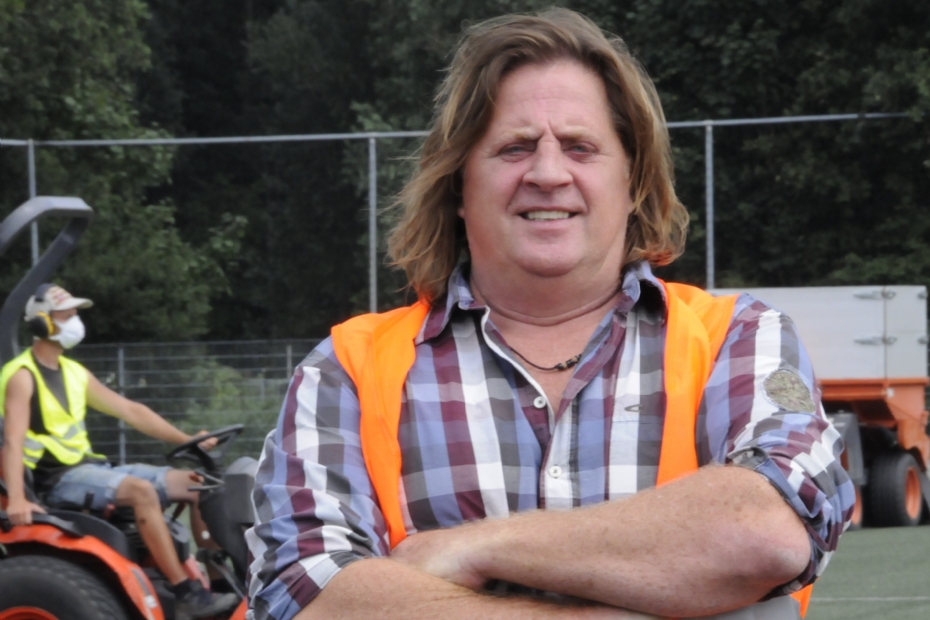 | | John van Gennip |
|
|
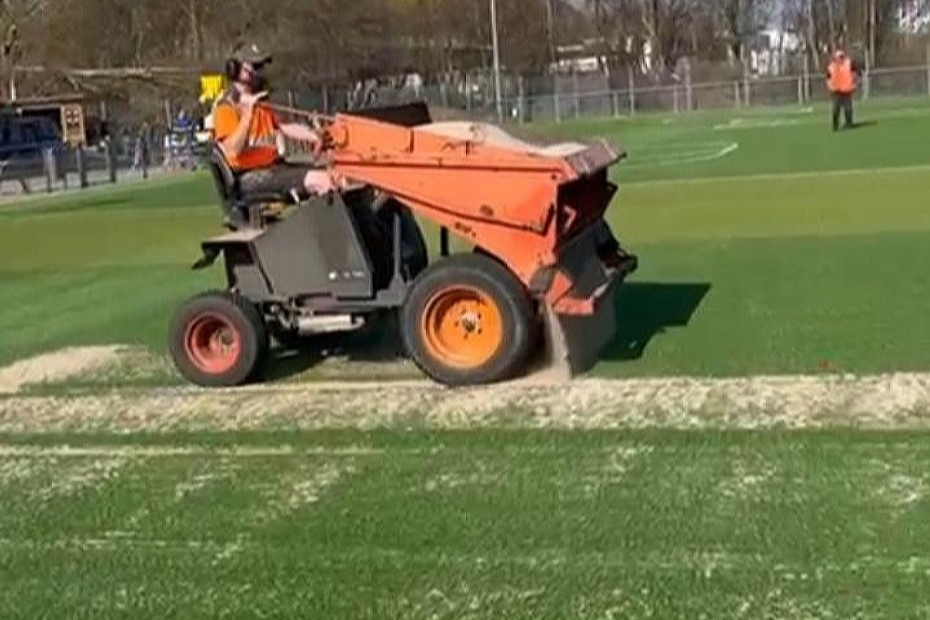 | | Working with controlled sand processing using tipping trucks and clamping buckets |
|
|
From Sibelco, sports & leisure manager Yannick van Bolhuis says: 'Moistened sports sand is already an option for all customers today. We are continuously in consultation with customers to find the most suitable solution, taking into account application, logistics and processing. Customers can choose optionally moistened sand and there are also different transport options.' Van Bolhuis acknowledges that working with silos generally creates more dust than processing with tipping trucks, but at the same time points out that some level of dust is created during all handling of sand. It is the responsibility of the sand processor to take appropriate and sufficient protective measures. According to him, the options available on the producer side are also limited. 'Factors such as transport, transfer, weather conditions and processing on site all influence possible dust formation. During our production process, fine fractions are already removed as much as possible and we work together with customers to determine which logistical and technical solutions are most suitable for a project. Correct processing and compliance with safety guidelines remain essential.'
Working in dust clouds
|
|
'Safety should not depend on a few thousand euros in price difference'
| |
|
Losing tenders due to price differences
According to J&E, sand has still regularly been supplied without moisture treatment, or sometimes too wet, causing it to stick during processing. Van Gennip: 'As a result, we still had to find our own solutions.'
According to J&E, another issue is that working with the alternative solution of tipping trucks and clamping buckets has become more expensive in some locations than processing through silos and bulk trucks. Van Gennip: 'A clamping bucket quickly costs around €1,300 per day. That is a significant amount, but if silos continue to cause dust formation, we have to do something to be able to work safely.' However, this creates a problem in tenders, adds Korstanje: 'If we invest in safe working practices and someone else does not, we are simply more expensive and lose tenders. But safety should not depend on a few thousand euros in price difference, should it?' In addition to costs, knowledge also plays a role, according to him. Clients regularly order the sand themselves without it being clear how it will later be processed. 'Then moistening is sometimes not included at all.'
Grain hatch trailers
To work cost-efficiently while maintaining safety, J&E continues to use alternative methods. The company now uses grain hatch trailers - based on working methods from Germany - in which the sand is carefully removed from the trailer with a loader and brought onto the field. Korstanje: 'It is more cumbersome and requires an additional person, but it prevents enormous dust clouds. However, the real solution should simply be addressing the problem at the source.'
He and Van Gennip therefore believe that clients and specification writers should include clearer requirements regarding dust formation. 'For example, that sand with visible dust formation may not be used. Then the same rules apply to everyone.'
This article was previously published on 26 June 2026 on the website of Fieldmanager.
| LOG IN
with your email address to respond.
|
|
|
| There are no comments yet. |
|
| |
Anyone can place small ads for free through their own account.
Place a free ad
|
|
|
|





