Landscaper liable for repair costs after poorly installed patio |
|
|
|
|
 |
| 137 sec |
'People walked on the paving too soon' fails to convince court
A landscaper has been ordered to pay a client almost €8,000 following problems with the installation of a patio. The original job was worth just over €4,000. According to the landscaper, the poor condition of the patio was not his fault. He claimed that people had walked on the newly laid paving too soon, but the court rejected that defence. He was also not entitled to demand payment of the outstanding invoice before carrying out repairs.
 |
The job began in May 2024 with an assignment to renovate and repave a back garden. The agreed price was €4,050.78. The client paid €2,671.38 in advance. On 18 July, the landscaper informed the client via WhatsApp that the back garden was finished and that the joints needed 24 hours to cure. Five days later, a dispute arose over the result and the landscaper collected his equipment and left.
An expert who later inspected the patio identified a substantial list of defects. The edging was not properly installed, the gradient was incorrect, paving slabs differed in height and cut pieces did not fit properly. The joints were also uneven and the paving had not been laid symmetrically. The expert's conclusion was clear: the work had been carried out carelessly and without sufficient professional skill.
|
|
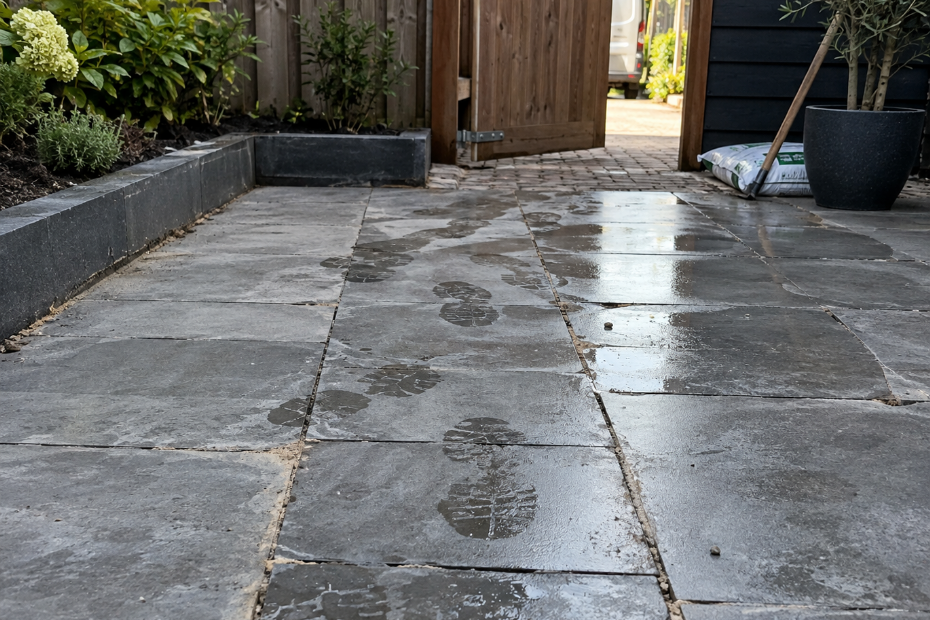
The wet footprints on the patio were not sufficient evidence for the court
| |
|
'People walked on it'
The landscaper had a different explanation. He argued that people had walked across the patio before the base had sufficiently hardened. He said he had warned against this and had also personally seen someone enter through the gate. As evidence, photographs were submitted showing wet footprints on the patio.
The footprints did not help his case. The expert acknowledged that walking on the paving too soon could cause differences in height, but considered that unlikely in this case. The height difference was in the middle of the patio rather than near the gate through which people were said to have entered. More importantly, it did not explain the other defects at all. The court therefore found that the landscaper had failed to provide sufficient evidence to support his defence.
Pay first, repair later?
The dispute then escalated further. Through his legal expenses insurer, the client gave the landscaper three weeks to remedy the defects. The landscaper did not do so. After that period had expired, he stated that he first wanted the outstanding invoice to be paid, after which a solution could be discussed.
This was precisely where the landscaper ran into a problem. His own quotation stated that labour costs were payable upon completion and acceptance of the work. Because of the defects, the client had not accepted the work and, according to the court, there had therefore been no formal completion. The outstanding amount of €1,379.40 was consequently not yet due. In this situation, demanding payment first and only then discussing repairs was therefore not an option.
More than €7,400
The court assessed the damage to the patio at more than €5,100. Part of this amount will be offset against the invoice that the client had not yet paid. In addition, the landscaper must pay costs including the expert's fees and legal proceedings. Altogether, the case will cost the landscaper more than €7,400, excluding statutory interest.
Avoid disputes over completion
It was precisely the completion of the work that caused problems in this case. The landscaper had issued a final invoice, but legally this did not mean that the work had been formally completed and accepted. Confirming completion in writing can prevent a great deal of discussion about this. Particularly when a client reports defects, it is important to take the complaint seriously, record agreements in writing and respond quickly.
Jelle Westra of TuinKeur sees many problems arise at this stage. 'Landscapers often simply send a final invoice even though the work has not yet been formally completed and accepted. Put the completion in writing and deal with complaints immediately; denying them or leaving them unresolved for months will only make a conflict worse.'
This article was previously published on 7 September 2026 on the De Hovenier website.
| LOG IN
with your email address to respond.
|
|
|
| There are no comments yet. |
|
| |
Anyone can place small ads for free through their own account.
Place a free ad
|
|
|
|





