Jens Reeuwijk uses a self-modified planting machine to plant flower bulbs in natural-looking patterns |
|
| GARDEN AND PARK TECHNOLOGY |
|
|
|
|
 |
| 213 sec |
'Everything was so uniform. Surely there had to be another way?'
A request from the municipality of Schagen got Jens Reeuwijk thinking two years ago. Could he plant flower bulbs mechanically, but without the characteristic uniform pattern? After a few Friday afternoons of tinkering, he had developed a machine that allows the number of bulbs planted to be varied while driving. Since then, naturalistic bulb planting has even started appearing in tender specifications, and Reeuwijk now uses his machine for municipalities and other clients.
| Jens Reeuwijk on his machine for planting bulbs in natural-looking patterns |
'Everything is planted in such straight lines.' That comment from an employee of the municipality of Schagen was enough to get Jens Reeuwijk, owner of Jens Reeuwijk Bloembollen B.V., thinking. The municipality wanted a more natural appearance for its flower bulb planting. 'I immediately thought: not bulb by bulb, but mechanically planted.'
Reeuwijk made the municipality a proposal. 'I said: if I come up with something that allows us to plant those bulbs in a more natural pattern, can I carry out a project for you?' The answer was yes. 'Well, challenge accepted.'
|
|
'You get areas with zero, fifty, 120 and three hundred bulbs. That's how those natural clusters appear'
| |
|
Friday afternoon tinkering
Then the experimenting began. Rather than building an entirely new machine, Reeuwijk started with an existing machine designed to plant bulbs beneath grass. Normally, the bulb feed is mechanically driven, distributing the bulbs evenly. Reeuwijk wanted to be able to control how many bulbs the machine released while driving. 'It really happened like this: we went into the workshop on a Friday afternoon to see what we could make. We took a small motor from the warehouse, added some hydraulic lines and modified the tractor.' Together with a mechanic, he dismantled part of the planting machine. The existing drive was replaced with a hydraulic motor, which also required modifications to the tractor. The result was surprisingly simple. 'Suddenly, we could control the bulb feed ourselves from the tractor. Turn the knob all the way up and lots of bulbs came out. Turn it just a little and only a few came out. We could manually control everything, from zero to full speed.'
Very little *fine-tuning* was needed afterwards. 'To be completely honest, it worked properly almost straight away.' Reeuwijk called the municipality. 'I said: I've done it.' Not long afterwards, he was able to carry out his first project using naturalistic bulb planting. He still uses the same machine today.
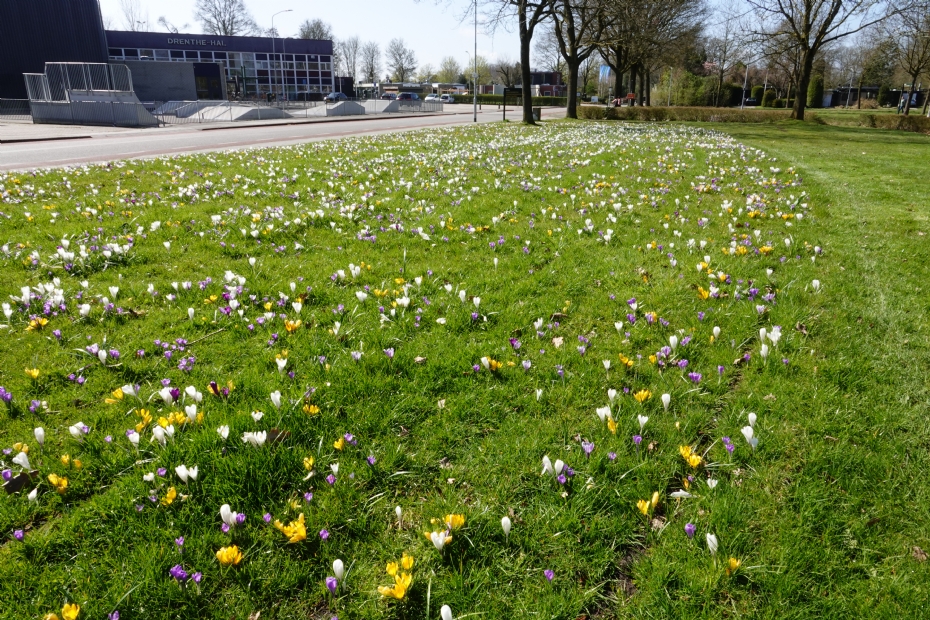 | | Flower bulbs planted in a natural-looking pattern |
|
|
From zero to three hundred bulbs
The main difference lies in the distribution. Conventional mechanical planting uses a fixed number of bulbs per square metre. With his modified machine, Reeuwijk constantly varies the density. 'We work with a range of zero to three hundred bulbs per square metre. On average, that works out at around 150.'
Some areas receive no bulbs at all, while a few metres further along, a dense cluster is created. 'You get areas with zero, fifty, 120 and three hundred bulbs. That's how those natural clusters appear.'
According to Reeuwijk, this also has a practical advantage. The same number of bulbs can be used to plant approximately twice the area. He sees particular potential in larger parks, estates and cemeteries. Instead of creating one prominent strip, a much larger area can be planted in a looser, more natural pattern. 'If you have a large planting area in a park, people often create a winding strip of bulbs somewhere within it. I say: why not plant the entire area? Then you have little groups of bulbs everywhere, just in a natural pattern.'
|
|
'With the same number of bulbs, we can plant twice as much area'
| |
|
Naturalistic planting is not suitable everywhere
Reeuwijk emphasises that naturalistic bulb planting is not the right solution for every location. Anyone looking for a striking display of flowers at the entrance to a village, on a roundabout or in front of a town hall would, in his view, be better off choosing traditional, dense planting. 'With daffodils or other more cultivated flower bulbs, sometimes you simply need to plant one really dense strip. Then people drive past and think: wow.'
He sees his modified planting machine primarily as a solution for places where a natural appearance is desired. These include parks, estates, cemeteries and woodland settings. He believes that historic woodland bulbs and naturalising bulbs are particularly suitable for this approach. 'Just take a look in a woodland. You'll see little clusters growing everywhere. If you distribute those bulbs neatly across a square planting bed, it actually looks as though someone deliberately planted them there.'
The irregular distribution should also allow the bulbs to spread naturally over time. 'It looks natural right from the start. What the bulbs do afterwards is up to nature.'
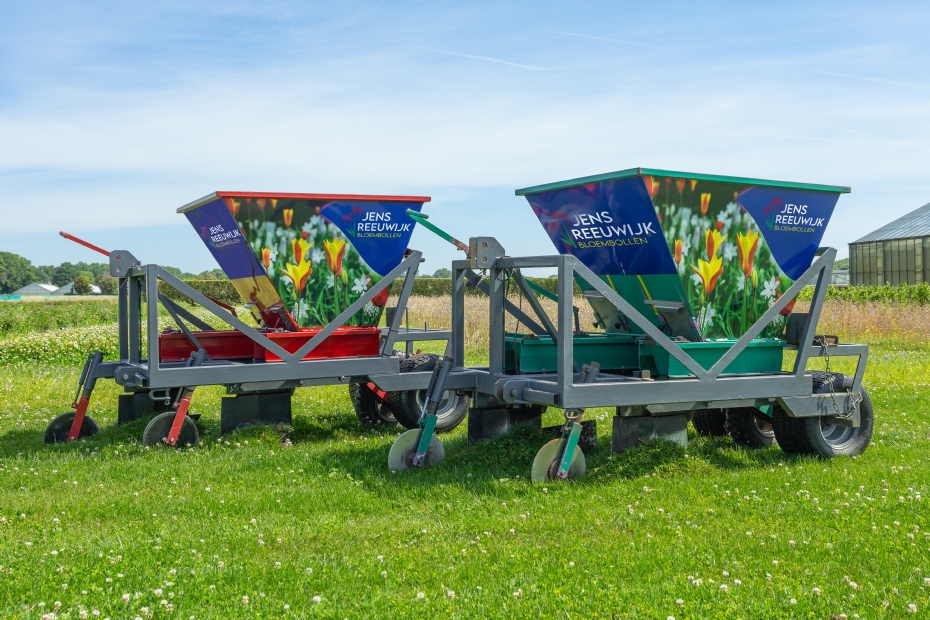 | | The machine for planting bulbs in natural-looking patterns |
|
|
Naturalistic planting in tender specifications
What began with a single request from Schagen is now something Reeuwijk is encountering elsewhere. 'So far, we've mainly done this for municipalities, but I'm now also seeing naturalistic bulb planting included in tender specifications.'
This sometimes surprises contractors. 'When I see naturalistic planting specified, I think: you're probably going to excavate the soil, scatter the bulbs by hand and then fill everything back in. That's when I say: you don't need to do any of that. I have a machine for it.'
Reeuwijk is also carrying out projects through contractors working for the Dutch Central Government Real Estate Agency, involving naturalistic planting of historic woodland bulbs and naturalising bulbs. 'We currently have three projects at defence sites. These involve biodiversity restoration and creating a more natural landscape, among other things.'
For such applications, Reeuwijk has also developed his own historic woodland bulb mixture, known as a Stinzen mixture. It contains only species associated with historic woodland and estate plantings that, according to him, occur in the Netherlands. The combination provides a relatively long flowering period, from approximately February through May.
|
|
'I tell contractors: there's no need to scatter the bulbs by hand. I have a machine for that'
| |
|
The fact that his naturalistic bulb planting machine began with a single practical request two years ago makes the achievement all the more satisfying for Reeuwijk. He now sees an increasing number of potential applications, particularly at larger, park-like locations. And if demand continues to grow, he does not expect the technology itself to be an obstacle. Building another machine? He does not need to think twice: 'That's no problem at all.'
This article was previously published on 12 October 2026 on the website of Stad + Groen.
| Jens Reeuwijk Bloembollen... | |
| |
| LOG IN
with your email address to respond.
|
|
|
| There are no comments yet. |
|
| |
Anyone can place small ads for free through their own account.
Place a free ad
|
|
|
|





