Tackling invasive alien species: earlier detection, more targeted control |
|
| GARDEN AND PARK TECHNOLOGY |
|
|
|
|
 |
| 187 sec |
From AI cameras scanning roadside verges to an adjustable rake underwater
Tackling a large infestation of Japanese knotweed or raking out a waterway choked with invasive plants is possible, but by then the problem is already well established. Increasingly, effective control of invasive alien species depends on earlier detection and more precise intervention. The Green Solution is exploring the use of AI cameras, while Harkboot.nl is developing an adjustable rake. Two very different innovations with the same objective: giving invasive species as little opportunity to spread as possible.
| Bo Binkhorst carries out the thermal treatment |
The best infestation is a small one
The Green Solution has been using thermal treatment to control Japanese knotweed for some time. A recent development is the use of a ground heat exchanger, which allows difficult-to-reach locations, such as ditch banks, to be treated. But according to Bo Binkhorst, the next step is not just about developing another control technique. Above all, the company wants to detect the plant earlier.
To achieve this, The Green Solution is working on a partnership involving AI cameras. These cameras can be mounted on vehicles or mowers, or suspended beneath drones. As the vehicle moves or the drone flies, the camera scans the area and can identify Japanese knotweed at an early stage. A small infestation can then be treated thermally within a few weeks.
According to Binkhorst, this could be particularly useful for municipalities. 'A few plants are relatively easy to tackle. If an infestation is discovered too late, the knotweed may already have spread considerably and could have been dispersed further during mowing operations, for example. Within the same season, it becomes a much bigger problem, making control more complicated and expensive.'
|
|
'Ideally, you want to intervene as soon as the first plants emerge'
| |
|
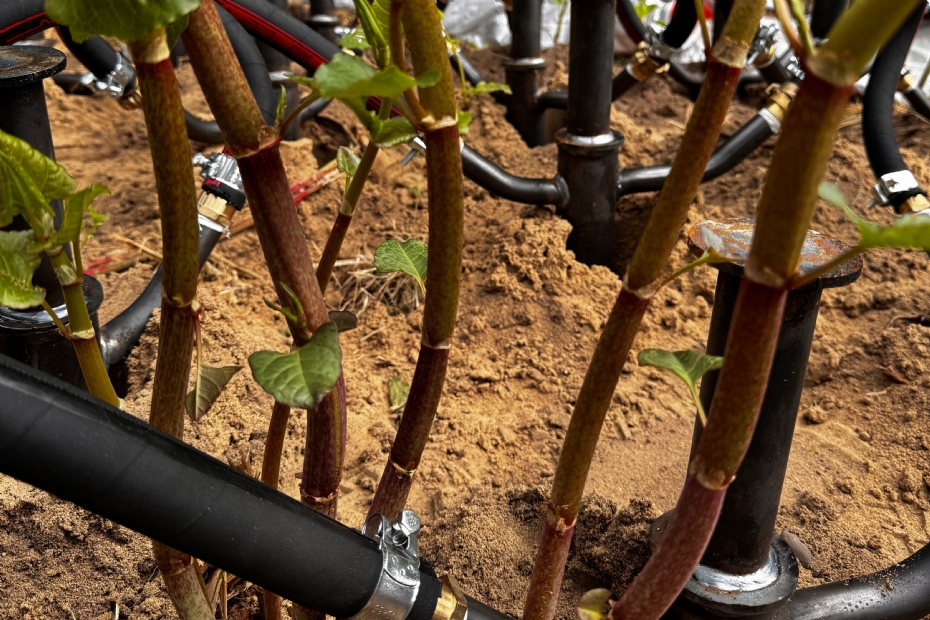 | | During this thermal treatment, pipes are inserted into the ground and connected by hoses to an automated control unit housed in a container |
|
|
Grouping small infestations together
Early detection alone is not enough. Sending a team out separately to treat every small infestation can actually make control expensive. The Green Solution is therefore exploring a model in which several small infestations within a region are grouped together. Binkhorst compares the idea to a service subscription: 'An area is scanned periodically, new infestations are recorded and then treated quickly. This should make early intervention more affordable, even for municipalities with limited budgets.'
The system is still under development. The Green Solution is working both on the AI camera partnership and on equipment that can treat small infestations precisely. This shifts some of the focus away from controlling large infestations towards preventing small ones from becoming established.
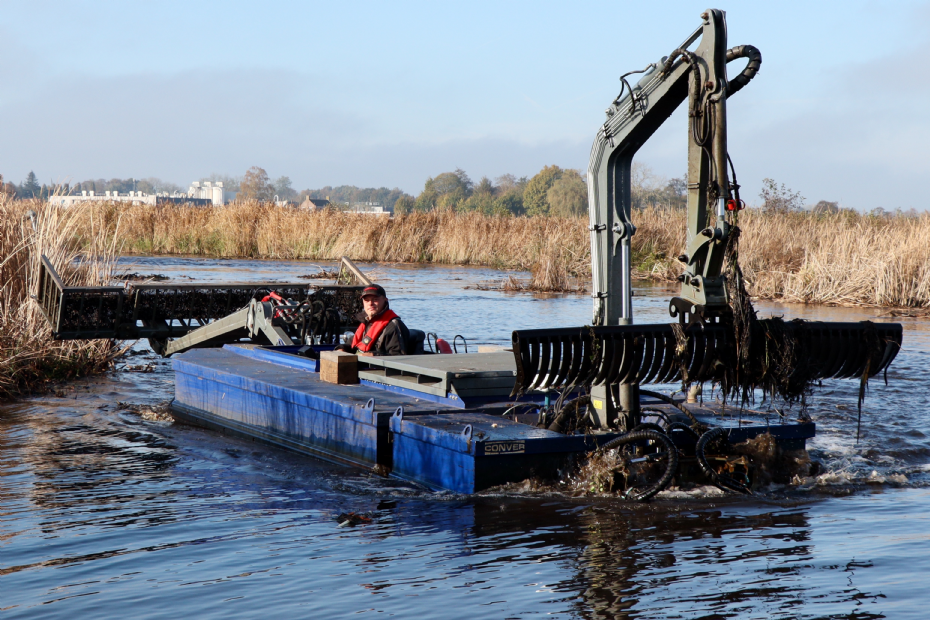 | | Rodney Postema working in the Weerribben-Wieden area |
|
|
Not every innovation needs to be high-tech
At Harkboot, innovation takes the form of a relatively simple mechanical modification. The company is increasingly using a tilting mechanism that allows its rake to be positioned at an angle. This means both the waterway bed and the sloping banks can be raked in a single pass.
'Previously, our rake was fixed and could not really tilt,' explains Rodney Postema. 'When working on a sloping bank, we had to position the tines against the bank and work downwards from there. That is less efficient, quite labour-intensive and makes it easier to miss something.'
That last point is particularly important when dealing with invasive aquatic plants. Plant fragments left behind can cause new problems. 'For some species, a fragment just a few centimetres long is enough. Hygiene therefore needs to be a top priority for companies working in aquatic environments and with aquatic plants.' According to Postema, recreational use of waterways can also contribute to their spread.
|
|
'We travel along the length of the waterway with the rake in a fixed position. That allows us to cover everything in a single pass'
| |
|
Only known location
Harkboot currently has four machines operating in Overijssel: two around Blokzijl and two near Ossenzijl in the Weerribben area. Near Ossenzijl, the company is controlling fanwort (Cabomba caroliniana), among other species. Around Blokzijl, according to Postema, the main problem is giant vallisneria (Vallisneria australis). He says this is currently the only known location of this invasive aquatic plant in the Netherlands.
'If you leave this plant unchecked, eventually it will be the only thing growing there,' says Postema. 'An area of several hundred square metres can become completely overgrown within a year.' According to him, the plant spreads mainly through its root system.
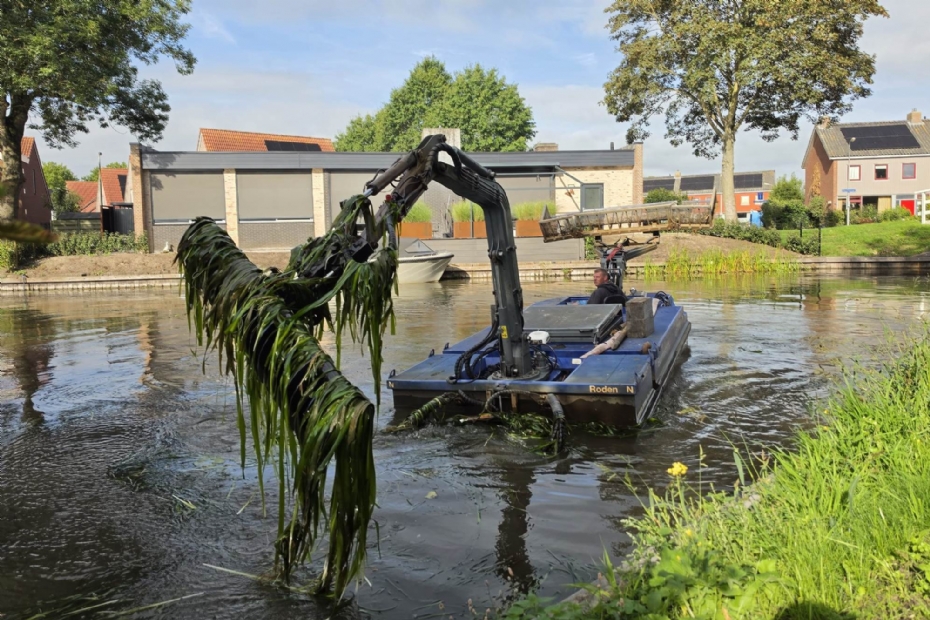 | | Harkboot's adjustable rake |
|
|
A combination of machinery and manual work
The adjustable rake makes operations more efficient, but controlling invasive aquatic plants will not become an entirely mechanical process. 'The machine is fairly large and cumbersome. That means we cannot reach every corner or every section of the bank,' says Postema. 'In those situations, manual work quickly becomes necessary. A lot of manual work is also needed to collect the last remaining fragments.'
The approach is therefore to treat as large an area as possible mechanically first. Afterwards, workers manually inspect difficult-to-reach locations and remove any remaining plants or fragments.
The innovations developed by the two companies are very different, ranging from artificial intelligence to an adjustable rake. What they have in common is less spectacular, but perhaps more important: identifying problems earlier and leaving as little behind as possible during control operations.
|
|
'In practice, it is almost always a combination of the two'
| |
|
Harkboot develops toolkit for aquatic plant management
Harkboot has developed a practical toolkit for identifying and managing aquatic plants. A plant identification guide helps users recognise different species, while a seasonal calendar provides information about their growth cycles and the best time to intervene. The 2027 edition is currently being prepared and will also incorporate feedback from users. The plant identification guide can be requested free of charge by emailing info@harkboot.nl. A future edition of Stad + Groen will take a closer look at the toolkit.
|
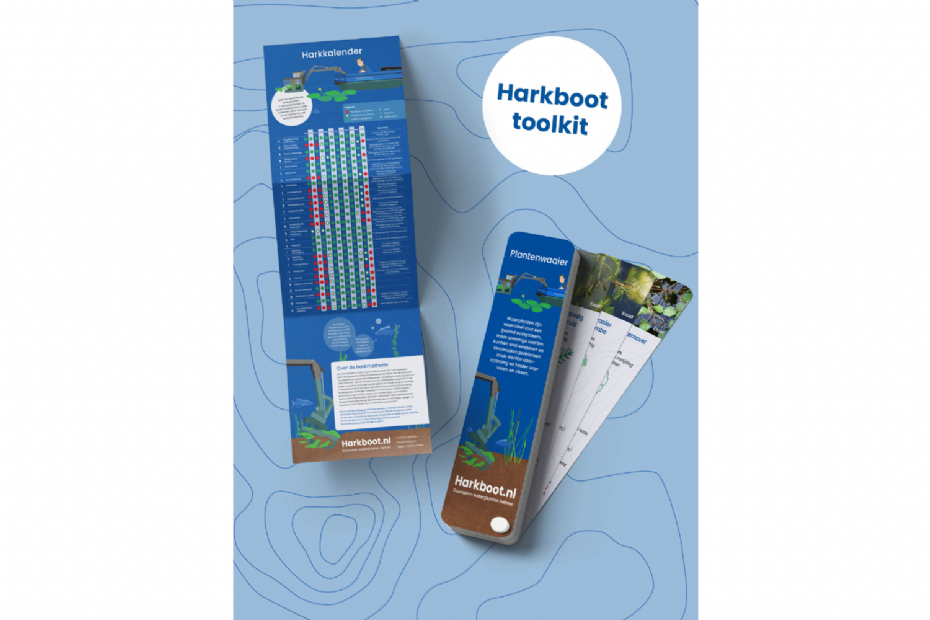 | | The toolkit, including the raking calendar and plant identification guide |
|
|
This article was previously published on 9 November 2026 on the website of Stad + Groen.
| LOG IN
with your email address to respond.
|
|
|
| There are no comments yet. |
|
| |
Anyone can place small ads for free through their own account.
Place a free ad
|
|
|
|


