Successful overseeding starts with timing, soil temperature and variety selection |
|
| GARDEN AND PARK TECHNOLOGY |
|
|
|
|
 |
| 193 sec |
Jan van den Boom: 'The Grass Guide proves it: the weakest diploid is still better than the best tetra'
Overseeding remains essential for many field managers to keep sports pitches dense and playable. However, success depends heavily on soil temperature, timing and selecting the right grass variety. According to Jan van den Boom of Barenbrug, the discussion surrounding tetraploid varieties sometimes receives more attention than actual field performance.
| Archive photo Fieldmanager magazine (photo: Hein van Iersel) |
In practice, soil temperature remains the most important success factor for overseeding. According to Van den Boom, the fastest perennial ryegrass varieties (both diploid and tetraploid) begin germinating at around 8 degrees Celsius, while slower varieties require temperatures closer to 12 degrees. 'A safe and realistic average is 10 degrees,' says Van den Boom. Only specific varieties such as SOS can germinate at approximately 3 to 4 degrees Celsius. SOS is not a perennial ryegrass but an improved Westerwolds ryegrass. According to Van den Boom, this also explains why overseeding in February and March often produces inconsistent results. At the same time, this early period is important for repairing damaged areas and reducing the opportunity for annual meadow grass to establish itself. Experienced field managers therefore see spring overseeding mainly as an initial recovery step ahead of major maintenance later in the season.
 | | Jan van den Boom, Barenbrug |
|
|
|
|
You do not need to use more kilos, but you do need to spread them more effectively
| |
|
Spreading applications throughout the season
In practice, many field managers deliberately choose several light overseeding applications spread throughout the year. Annual application rates of approximately 150 to 180 kilograms of grass seed are not uncommon, divided between spring, summer and autumn. According to Van den Boom, these figures should mainly be seen as practical averages. 'Sometimes you will need to overseed more heavily, and sometimes 180 kilograms is more than enough. It largely depends on pitch usage and construction.' 'Five light overseeding applications often work better than one very heavy application. Ultimately, the goal is not to sow as much seed as possible, but to establish as many successful plants as possible.' The type of pitch also plays a role. A training pitch used daily naturally requires a different approach than a match pitch used only at weekends. Van den Boom also points to the stolon-forming characteristics of his RPR perennial ryegrass. The idea is that one seed produces multiple grass plants rather than just one.
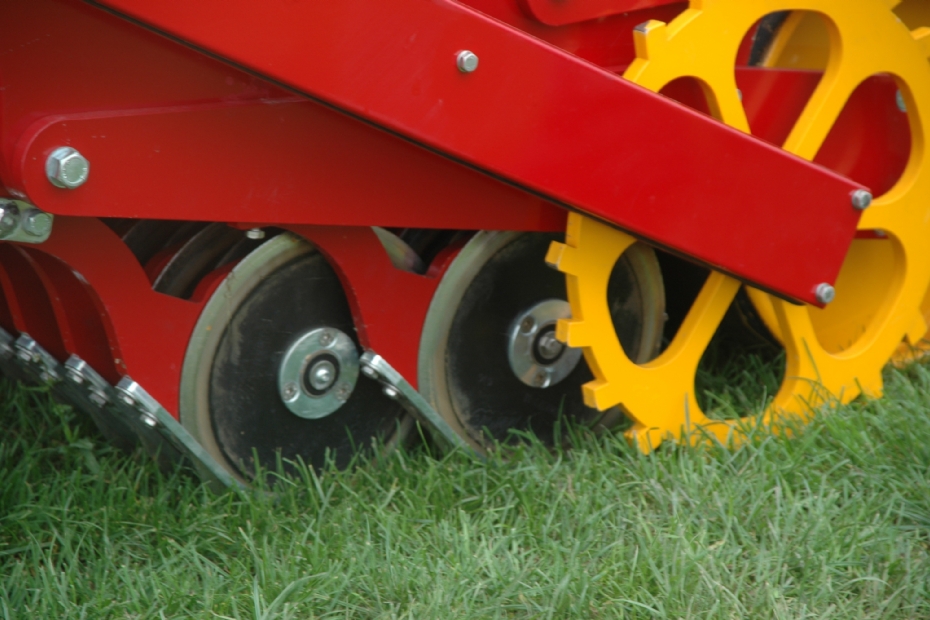 | | Overseeding with a Vredo machine; besides timing, seed-to-soil contact remains crucial |
|
|
Seed-to-soil contact
Besides timing, seed-to-soil contact remains crucial. Overseeders, harrows and scarifiers help improve the movement of heat, air and moisture into the top layer of the soil. At the same time, these operations stimulate existing grass growth and reduce opportunities for annual meadow grass. Particularly in early spring, this effect can sometimes be more important than the germination of newly sown seed itself.
Autumn remains the safest period
According to Van den Boom, autumn (September-October) remains the most reliable period for overseeding. Soil temperatures are warm and moisture levels are generally favourable, giving seed sufficient time to establish. Spring applications are primarily corrective and require careful management of weather conditions and moisture levels. In practice, guideline figures are used for seed quantities. Rather than applying large amounts at once, the focus is increasingly on spreading applications throughout the season. A common guideline is approximately 150-180 kilograms of grass seed per year, divided over several applications:
• spring: 2 applications of approximately 20-25 kilograms
• summer/recovery: up to approximately 80-90 kilograms
• autumn: 1 to 2 applications of approximately 20-25 kilograms
A clean top layer is essential
Discussions with field managers in Fieldmanager magazine and its sister publication Greenkeeper reveal a similar conclusion: keeping the top layer 'clean' is an important prerequisite for a strong turf surface. This means keeping the upper layer free from thatch, annual meadow grass and organic build-up so that air, water and heat can penetrate more effectively. Achieving this requires regular mechanical intervention and continuous monitoring of soil conditions. This approach forms the foundation for both stimulating existing grass and ensuring successful overseeding.
Overseeding and fertilisation
Overseeding cannot be separated from the nutrition provided to the turf. Soil temperature is also the key factor here. Below approximately 8 degrees Celsius, root activity remains limited, reducing the uptake efficiency of nitrogen and other nutrients. Renovation guidelines therefore often recommend overseeding with perennial ryegrass first, followed immediately by a starter fertiliser, such as an NPK fertiliser with a 9-6-9 analysis. Irrigation is then applied to initiate germination. Fertilisation is regarded as an integral part of the overall overseeding strategy.
Critical of tetraploids
Within this general approach, Barenbrug clearly favours diploid sports turf varieties. The company questions the current popularity of tetraploid varieties. According to Van den Boom, the benefits of tetraploids are sometimes presented too one-sidedly. Tetraploid varieties are said to offer better tolerance to salinity and diseases. Van den Boom does not dismiss these advantages, but argues that they are not the most important characteristics for the average local sports pitch. 'For an average sports pitch, wear tolerance and recovery capacity are the key criteria to consider.' He specifically refers to the Grass Guide. 'When you look at the figures, you can see that even the weakest diploid scores better for wear tolerance than the best tetra.'
Comparison of diploid and tetraploid perennial ryegrass for wear tolerance
| Diploid perennial ryegrass |
| , Wear tolerance |
| Tetraploid perennial ryegrass |
| , Wear tolerance |
| Barbasten |
| 8.3 |
| Tetragame |
| 7.9 |
| Reybann |
| 8.4 |
| Fabian |
| 7.7 |
| Saila |
| 8.3 |
| Tetramagic |
| 7.4 |
| Lamar |
| 8.4 |
| Tetragon |
| 7.3 |
| Bargkamp |
| 8.3 |
| Barquad |
| 7.2 |
| Eurobeat |
| 8.3 |
| Double |
| 6.6 |
| Barabins |
| 8.1 |
| Tetrasport |
| 6.4 |
| Source: GRASGIDS '26 |
| |
| |
| |
|
|
For a sports pitch, wear tolerance remains the most important criterion
| |
|
Miracle variety
According to Van den Boom, this brings the discussion back to the practical reality of turf management: success is not determined by a single miracle variety, but by the combination of timing, conditions and a strategy that matches the level of pitch usage.
This article was previously published on May 30, 2026, on the website of Fieldmanager.
| LOG IN
with your email address to respond.
|
|
|
| There are no comments yet. |
|
| |
Anyone can place small ads for free through their own account.
Place a free ad
|
|
|
|