UV-C LED Lighting: A Practical Technology for Controlling Diseases in Sports Turf |
|
| GARDEN AND PARK TECHNOLOGY |
|
|
|
|
 |
| 262 sec |
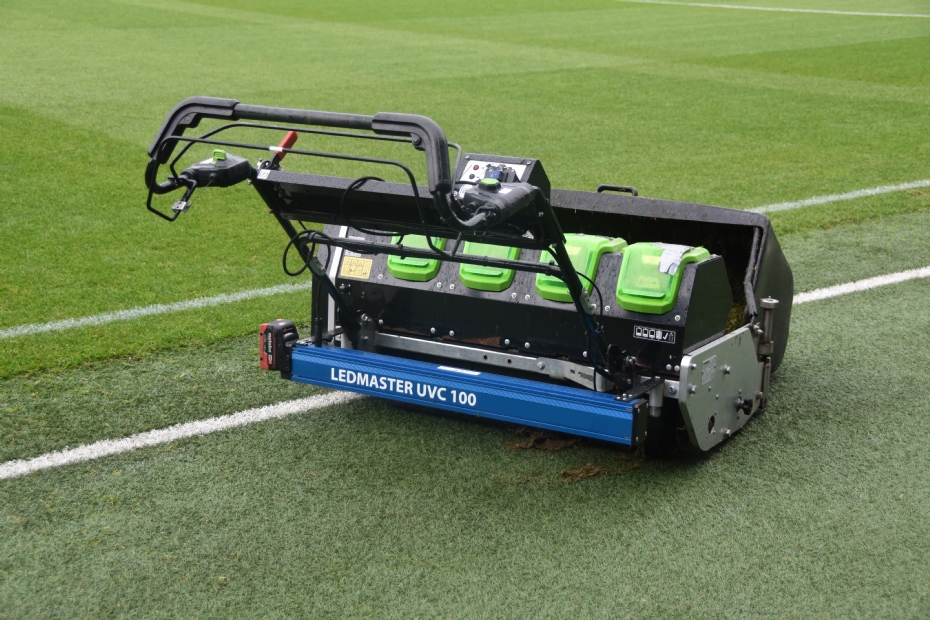
For ground managers, the pressure to keep sports pitches in good condition shows no sign of easing. Chemical treatments are gradually being phased out, whilst performance requirements remain high. This quickly raises the question of which techniques are actually viable in practice. According to Felix Oudshoorn, inventor of the UV-C LEDMASTER, and Mark van der Ende of manufacturer Agroled, this presents an opportunity for UV-C LED lighting. Not as a miracle cure, but as a technique that is complementary to what groundkeepers already are doing: mowing.
 |
The aim is clear: to reduce fungal pressure without requiring an additional treatment. The technique focuses primarily on reducing foliar disease pressure such as red thread and dollar spot and should be viewed as a system of repetition and dosage, integrated into the overall management of the field. UV-C is a form of ultraviolet light with a short wavelength and therefore houses a high energy content. At a wavelength of approximately 265 nanometres, this light can damage micro-organisms. When fungi are exposed to it, their DNA is disrupted, preventing them from developing or multiplying further. In practice, this means that the activity of pathogens is significantly inhibited, provided the dose is high enough. That dose is determined by a combination of light intensity, distance and time - in other words, the amount of energy reaching the surface. Oudshoorn puts it simply: 'You must think of it as a severe sunburn for microorganisms. They don't recover from it.'
UV-C as a technology is not new. Systems using mercury-containing gas discharge lamps have been on the market for some time. The difference with the new generation lies in the use of LEDs. Whereas traditional lamps emit a broad spectrum, the LEDMASTER produces a single specific wavelength of 265 nanometer. This is also known as monochromatic light. According to Van der Ende, this makes a significant difference in effectiveness. "We produce light only at that one peak. With traditional lamps, only a small portion of the light is truly effective." In addition, gas discharge lamps emit light in all directions, whereas LEDs, when equipped with a lens, shine downward in a focused beam. As a result, a much larger portion of the energy actually reaches the turf. This means that the required illumination time remains short, and microorganisms can be targeted within a fraction of a second.
|
|
"You don't need any extra man-hours. You're already mowing"
| |
|
The main difference lies not only in the technology, but above all in its application. The LEDMASTER was developed as a compact bar that mounts onto a mower. This fundamentally changes how it's used: treatment takes place while mowing, without requiring a separate pass. Van der Ende says: "You don't need any extra man-hours. You're already mowing." For field managers, this is a decisive advantage, because time and capacity are often the limiting factors in maintenance.
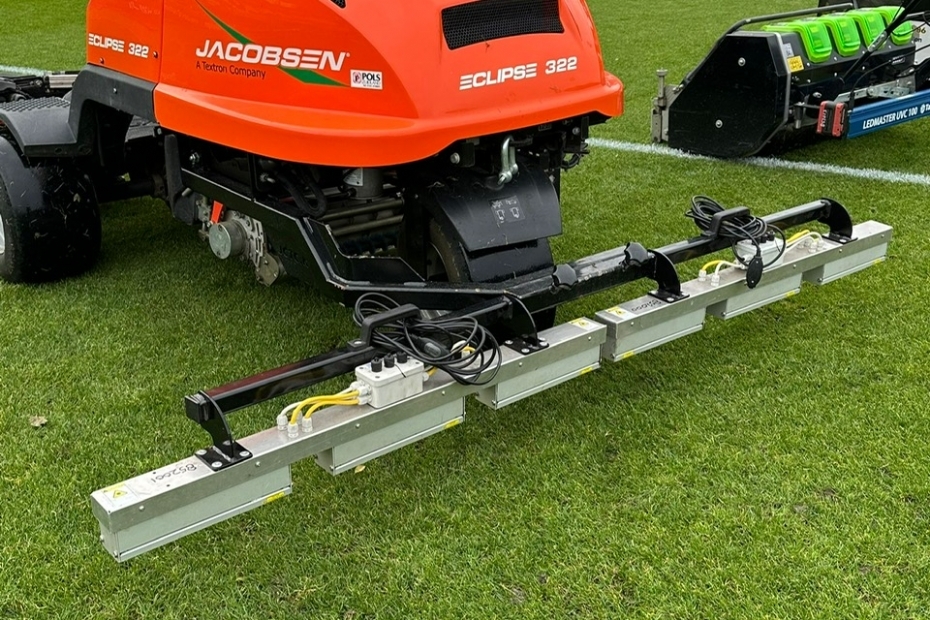 | | Two prototypes deployed at ADO in February 2023, mounted at the rear of a Jacobsen 322 ride-on mower. |
|
|
Most Vulnerable
The position of the light bar on the mower was deliberately chosen. When mounted behind the mower, the UV-C treatment follows immediately after mowing. That is precisely the moment when the grass is most vulnerable. Mowing creates open wounds in the blades of grass, where pathogens specifically try to take hold. Oudshoorn emphasizes that moment: "The sap flow is exposed at that point. That's the main entry point for fungi." Treating that wound immediately greatly reduces that risk. It is precisely the combination of mowing and treating in a single operation that makes the technique practical and effective
The effectiveness of UV-C depends entirely on the correct dosage. In practice, this means that speed, operating height, and frequency determine the result. At a typical operating speed of about four to five kilometers per hour and an operating height of around ten centimeters, sufficient energy is delivered to the grass to be effective. When operating at a faster speed or at a greater distance from the grass, the amount of energy per square meter decreases, and so does the effect. For existing infestations, the dose can be increased by driving more slowly or treating more frequently. The system works cumulatively: each treatment contributes to further reducing fungal activity. It is not the intensity of a single treatment that is decisive, but rather the regularity with which it is carried out.
Since 2023, the technique has been used on pitches at ADO Den Haag and Sparta, amongst others. There, the pitch is mown several times a week using the module fitted to the mower. In practice, it has become apparent that the openness of the turf plays a role. This benefit is particularly evident in the period following a renovation. In an open turf, light can reach the soil more easily and have an effect there too, for example in the case of diseases such as Pythium. The mowing technique also plays a role. By mowing in different directions, the foliage is better exposed and coverage is increased. In the case of diseases such as red thread and Fusarium, those involved report that visible results have been achieved by temporarily increasing the frequency of treatment.
An important question in practice is what effect UV-C has on young grass or a reseeded pitch. Experience (as there is no international literature providing a definitive answer) shows that the germination capacity of grass seeds is preserved. Young grass may show a slight reaction, but this usually recovers quickly. This means the technique can also be used in situations where reseeding or renovation is taking place.
|
|
The technology should therefore be viewed as part of a broader maintenance system
| |
|
UV-C is only effective where the light actually reaches. This makes the technology particularly suitable for short-cut sports turf, such as football pitches and golf greens. In taller grass or rougher terrain, its effectiveness decreases, as the light does not penetrate the foliage and soil as well. Deeper-seated problems in the root zone are not directly addressed, but by keeping fungal pressure on the foliage low, further development is inhibited. The technique should therefore be viewed as part of a broader maintenance system, in which factors such as nutrition, water management and soil aeration remain at least as crucial. A practical advantage is that UV-C leaves no residue. Unlike chemical treatments, there are no fixed application times and there is no risk of leaching into the environment. Weather conditions also play a much smaller role. In principle, the treatment can be carried out under a wide range of conditions, which makes planning easier
Don't stand still
The light bars are robustly built and suitable for use in a wide range of conditions. They are waterproof and easy to maintain; keeping the lenses clean is usually sufficient. Power is supplied by a replaceable battery with a runtime of several hours, sufficient for a regular mowing session. Operation is relatively straightforward but does require attention. The most important point to note is that the machine must not be left stationary whilst the system is switched on, as this will result in an excessively high localised dose. Under normal use, where mowing is carried out continuously, this risk does not arise. The investment is around €8.200,- per unit. In practice, this means that two units are often required per field, depending on the working method. On the other hand, operating costs are low to zero and savings can be made on chemicals and additional treatments.
A logical addition
UV-C LED lighting is not a quick fix that solves all problems in one go. It requires a different way of working, centred on regularity and integration into maintenance routines. Precisely because the system operates as part of the mowing cycle, it is practical to implement and fits in with the field manager's day-to-day routine. For managers who must work without using chemicals, it therefore offers a useful and logical addition. As Van der Ende sums it up: 'Just hang it on, and you can simply forget about it.'
| LOG IN
with your email address to respond.
|
|
|
| There are no comments yet. |
|
| |
Anyone can place small ads for free through their own account.
Place a free ad
|
|
|
|





