Solheim Cup gives John Deere and Kraakman a new opportunity in the Dutch golf market |
|
| GARDEN AND PARK TECHNOLOGY |
|
|
|
|
 |
| 297 sec |
Bernardus moves towards electrification ahead of the Solheim Cup
For John Deere and distributor Kraakman, there is still ground to gain in the Dutch golf market. The Solheim Cup at Bernardus offers an interesting platform to do so. Winning the tender gives Kraakman an excellent opportunity to demonstrate what it can offer as a supplier: not only in terms of machinery, but also in service and support.
| Line-up of John Deere machines in front of the maintenance facility |
John Deere seized the opportunity at the end of August by inviting a group of international golf and greenkeeping journalists to Bernardus. Greenkeeper magazine attended on behalf of the Netherlands. The purpose was clear: to show the role John Deere and Kraakman are playing in preparations for the Solheim Cup and which machines are being used at Bernardus. The international golf tournament will be held at the Brabant course from 11 to 13 September.
For Bernardus, the partnership goes beyond the event itself. Golf course superintendent Niall Richardson switched a large part of his machinery fleet from Toro to John Deere. In his presentation to the press, he cited electrification, software and data as important reasons for the decision. His relationship with Kraakman also played a role. 'This industry is all about relationships,' says Richardson. 'It was a big step for me to move from one brand to another.' According to him, confidence in the machines and local support were ultimately the decisive factors.
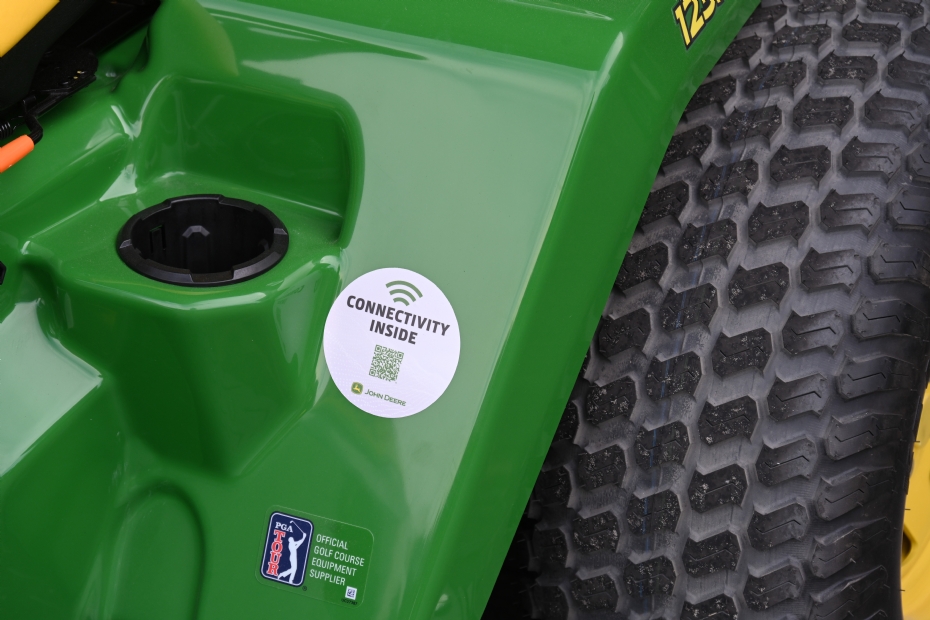 | | The machine itself is important, but connectivity and the data generated by the machine are becoming increasingly important |
|
|
From greens mower to bunker rake
Electrification runs throughout the new machinery fleet. One of the key machines is the 2775 E-Cut, a fully electric ride-on mower for greens and surrounds. Bernardus also uses electric 225 E-Cut walk-behind greens mowers. The fleet also includes hybrid machines with electrically driven cutting units, including machines from the 6000 and 8000 series.
The bunker rake is also going electric. An electric John Deere bunker rake arrived shortly before the international press visit and will remain at Bernardus. The golf course had previously purchased a John Deere GPS sprayer, more precisely a 2030A Pro Gator diesel with an HD200 GPS sprayer. According to Richardson, that was actually the first step towards the brand. GPS and automatic steering help prevent overlap during spraying. Richardson says this saves around 20 percent in product use.
For him, the move to electric is not just about emissions. 'I see electrification as a double-edged sword, because the raw materials have to come from somewhere too.' One important practical advantage, he says, is the quieter course environment. Electric machines produce less noise and therefore fit Bernardus's ambition to limit its impact on the natural environment.
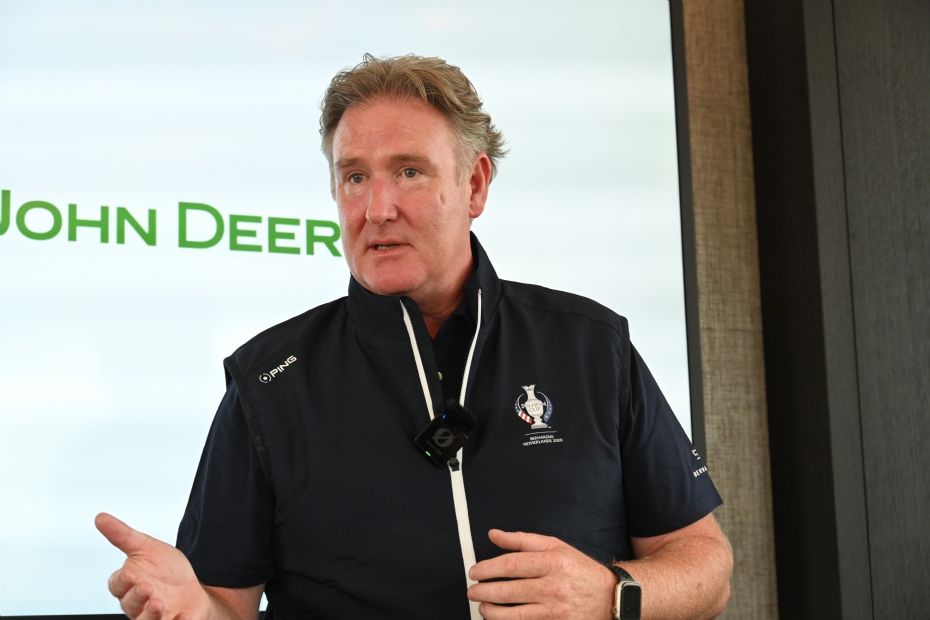 | | Niall Richardson, golf course superintendent at Bernardus |
|
|
Additional fleet for the Solheim Cup
Bernardus's own machinery fleet is only part of what will be available during the Solheim Cup. John Deere and Kraakman are providing an additional fleet for the event. This includes five 2775 E-Cut mowers, five 225 E-Cut walk-behind mowers, additional machines from the 6000 and 8000 series and twelve Gators. In total, at least forty John Deere machines will be on site at Bernardus during preparations.
Some of these machines come directly from other major golf tournaments. Machines previously used at events including The Open and the Women's Open at Royal Lytham in Great Britain have been brought to the Netherlands. Simply sending them on was not an option. The machines first had to be reconfigured for the conditions and requirements at Bernardus. Eleven-blade cutting cylinders, for example, were replaced with different cylinders. Such details matter because Richardson wants the temporary machines to be set up in the same way as his own fleet. His greenkeepers and the dozens of volunteers helping during the Solheim Cup need to be able to use the machines without major adjustments.
|
|
I see electrification as a double-edged sword
| |
|
Support goes beyond machinery
Technical staff are also part of the package. During the tournament, Kraakman will have a mechanic in the workshop at Bernardus. The mechanic will provide support with maintenance, grinding and other work on the machines. John Deere will also provide technical support. This is no unnecessary luxury: in addition to his permanent team of eighteen greenkeepers, Richardson will have the support of around seventy volunteers during the tournament. Depending on the day, he says between ninety and one hundred people will be involved in course maintenance. Richardson stresses that his decision was not based solely on the Solheim Cup. 'In three weeks, the tournament will be over. The machines I have bought will be here for the next four years. I want to make sure they continue to do their job afterwards.' According to him, Kraakman's support was therefore an important factor in the switch.
Thirty years in the profession and still learning
Interestingly, Richardson did not only consider drive systems, emissions or support when selecting the new machines. He is particularly interested in the ability to adjust a mower more precisely to the grass species. This also relates to his own experience at Bernardus. Richardson openly admits that when the golf course was first established, he had not specified the right mower configuration himself. He came from golf courses dominated by bentgrasses. That was his frame of reference. 'I basically did a bit of *copy paste*: I used that type of mower at my previous course, so I thought I would use it here as well.' After several years, he began to wonder why he was not getting the quality of cut he wanted. A machinery specialist pointed out that his configuration was better suited to bentgrass than to the red fescues used at Bernardus.
Red fescue requires a completely different approach. Richardson therefore wants to be able to configure his machines specifically for that grass and for the conditions at any given moment.
Addicted to reel speed
This is where adjustable reel speed comes into play. On the John Deere mowers, Richardson can adjust the rotational speed of the cutting cylinder. It may sound like a minor detail, but according to him it gives the greenkeeper an additional tool for highly targeted and almost strategic mowing. A high *reel speed* is not always better. With longer or wider leaves, the airflow generated by a fast-rotating reel can push the grass away from the cutting unit. By reducing the reel speed and combining this with the correct forward speed, Richardson says the leaf has more opportunity to enter between the reel and bedknife and actually be cut.
He also uses this option to target undesirable grasses. On one day, for example, the setting can be aimed at coarser grasses and annual meadow grass seedheads, while a few days later he can switch back to a setting for red fescue. As an example, Richardson mentions a setting of around 1,450 revolutions per minute for red fescue at a forward speed of 5.2 kilometres per hour. The exact setting, however, depends on grass species, soil, climate and the firmness of the greens.
Where such adjustments previously had to be made mechanically on each machine, Richardson can now set the reel speed via the control panel. He stresses that this cannot yet be done remotely from the office. That next step in machine control is still under development.
Green speed is not everything
This ultimately brings Richardson to a broader discussion within the greenkeeping profession. According to him, green speed often receives a great deal of attention, but on its own it is not a good measure of green quality. High ball speed has little value if achieving it damages the grass plant.
'You can have a high green speed, but if you damage the plant and then get one or two weeks of difficult weather, you can get a lot of disease or your greens can burn. You have to keep finding the balance.'
This approach is also reflected in the way Bernardus will be maintained during the Solheim Cup. Richardson does not automatically expect to mow twice a day, as is common on bentgrass courses during major tournaments. The red fescue greens will in any case be mown and rolled in the morning. Later in the day, a light hand roller may be used if necessary. Doing more simply because it is a major tournament is not an automatic choice, according to Richardson. 'You can also damage the grass by working it too much.'
For John Deere and Kraakman, the Solheim Cup therefore provides an international showcase. For Richardson, the measure of success is ultimately much simpler: not how much technology a machine contains, but whether he can use that technology to give the grass what it needs at that particular moment.
Machinery package during the Solheim Cup
16x 225E greens mowers
8x 225E tee mowers
8x 2775E surround mowers
10x 8000E fairway mowers
3x 6080AE fairway mowers
1x 1235 electric bunker rake
12 TE Gators
14 x 22 trailers for the walk-behind mowers
3x 2030A Pro Gator diesel
1x 2030A Pro Gator diesel with HD200 GPS sprayer
1x 2030 electric Pro Gator
2x 4066R compact tractors
1x 3046R compact tractor
1x electric Kramer KT telehandler
6x GS Gators
|
This article was previously published on 31 August 2026 on the Greenkeeper](https://www.greenkeeper.nl/article/55366/solheim-cup-geeft-john-deere-en-kraakman-nieuwe-kans-op-nederlandse-golfmarkt]Greenkeeper) website.
| John Deere Walldorf GmbH ... | |
| |
| LOG IN
with your email address to respond.
|
|
|
| There are no comments yet. |
|
| |
Anyone can place small ads for free through their own account.
Place a free ad
|
|
|
|