Silver Y moth can slow New Zealand pigmyweed, but cannot control it |
|
|
|
|
 |
| 79 sec |
Field trial shows an effect when caterpillar numbers are high
Caterpillars of the native silver Y moth can cause considerable feeding damage to New Zealand pigmyweed. However, they are not suitable as a standalone control method for this invasive species. This is the conclusion of a field trial by Stichting Bargerveen in the Dintelse Gorzen.
| New Zealand pigmyweed (image for illustration, generated with AI) |
Stichting Bargerveen previously investigated in greenhouse trials whether silver Y moth caterpillars feed on New Zealand pigmyweed. The trials showed that the caterpillars can cause considerable damage to the plant. A field trial was therefore carried out in the Dintelse Gorzen in the summer of 2025, a nature reserve along the Volkerak where New Zealand pigmyweed has become widely established.
For the trial, 37 small vegetation plots were enclosed. Twenty, forty or no silver Y moth caterpillars were introduced into the plots. The amount of damage caused by the caterpillars to the New Zealand pigmyweed was then monitored for several weeks.
|
|
New Zealand pigmyweed was only significantly suppressed at high caterpillar densities
| |
|
Reduction of up to 1.5 centimetres
Feeding damage was visible in almost all trial plots containing caterpillars. However, a strong effect occurred only at the highest density of forty caterpillars, in locations where the native sea milkwort was growing alongside New Zealand pigmyweed.
In some locations, the thickness of the New Zealand pigmyweed mat decreased by up to 1.5 centimetres within three weeks. In the trial plots without caterpillars, the mat instead increased by 3 centimetres over the same period.
|
|
Without caterpillars, the New Zealand pigmyweed mat increased by 3 centimetres in three weeks
| |
|
New Zealand pigmyweed recovers quickly
At the same time, the trial demonstrated how vigorous New Zealand pigmyweed is. Where the invasive plant was already completely dominant at the start of the trial, the caterpillars could not keep pace with its growth. Two weeks after the caterpillars had pupated, the New Zealand pigmyweed had almost completely recovered from the feeding damage.
According to Stichting Bargerveen, introducing silver Y moth caterpillars is therefore not a standalone method for tackling large areas of New Zealand pigmyweed. Combining them with other management measures may offer more potential. If the dominance of New Zealand pigmyweed is first reduced by other means, natural herbivory may help the original vegetation recover.
|
Natural herbivory may be most effective as a supplement to other management measures
| |
|
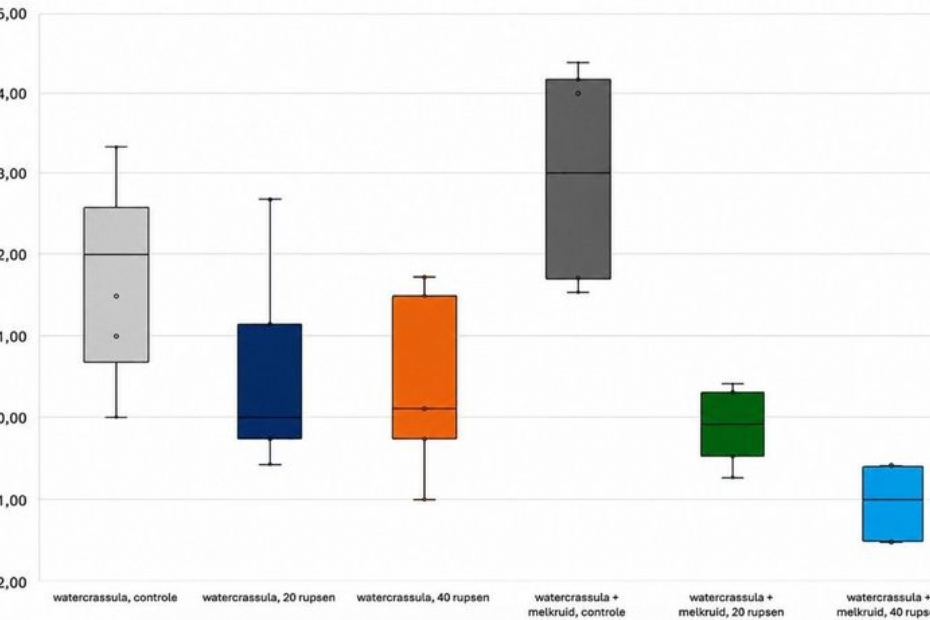 | | The thickness of the New Zealand pigmyweed mat decreases due to caterpillar feeding (blue), while it continues to increase in the controls without caterpillars (light and dark grey). Source: Stichting Bargerveen |
|
|
This article was previously published on 11 September 2026 on the website of Stad + Groen.
| LOG IN
with your email address to respond.
|
|
|
| There are no comments yet. |
|
| |
Anyone can place small ads for free through their own account.
Place a free ad
|
|
|
|





