From beech avenue to mixed tree planting: visualize first, decide later |
|
|
|
|
 |
| 179 sec |
SmitsRinsma visualizations make future scenarios for historic avenues tangible
The straight tree avenues are an important part of the Colonies of Benevolence. But how do you keep such a historic structure recognizable when trees decline and climate, drought and tree diseases create new challenges? SB4 Bureau voor Historische Tuinen, Parken en Landschappen investigated various future scenarios for the avenues of the UNESCO World Heritage site. Project leader and European Tree Technician Daisy van Boven and illustrator Martijn Lijzen from SmitsRinsma contributed tree expertise and a great deal of imagination.
| Radical avenue concept: view with different tree species, an intermediate species and rejuvenation |
The Colonies of Benevolence in Frederiksoord-Wilhelminaoord and Veenhuizen, together with the Belgian Wortel, have been part of the UNESCO World Heritage list since 2021. The straight roads, plots, waterways and tree avenues together form a recognizable historic landscape. The planted avenues in particular are important for the structure and sightlines of the area.
SB4 previously developed a method for historic avenues that looks not only at the current trees, but first at the meaning of the avenue. Based on this, a target image can be selected: preservation and management, rejuvenation, controlled decline, removal or another approach. This method was applied, among other places, in Veenhuizen, Frederiksoord and Wilhelminaoord.
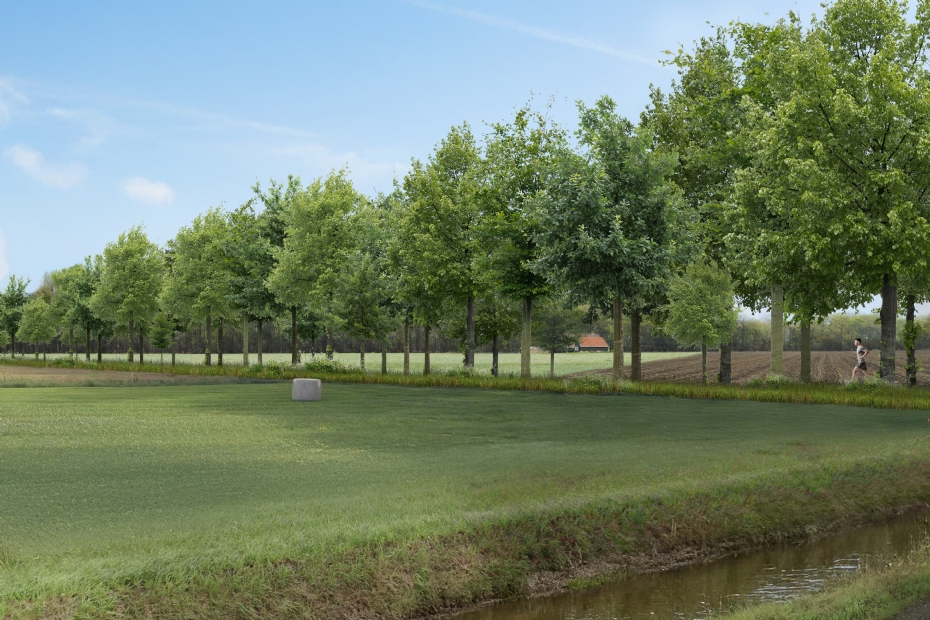 | | Avenue concept with one-to-one replacement: open landscape with different tree species and rejuvenation |
|
|
From tree memo to twelve scenarios
SmitsRinsma became involved in the project through an earlier collaboration with SB4. Initially, Van Boven expected mainly to provide advice on tree species. 'At first I thought about a species selection advice, a memo or something similar. It soon became clear that there was a need for something that could also clearly present the different possibilities.'
This led to the idea of 3D and Photoshop visualizations. 'Photos of existing avenues were used as a basis. Trees were digitally removed from the images and replaced by new species, structures and planting distances.' In the end, SmitsRinsma developed twelve different scenarios. The images and accompanying explanations were included in SB4's design book.
|
|
'We created a whole range of options'
| |
|
What makes the project special is how far the team was willing to go. Some proposals stayed close to the existing appearance. Van Boven: 'If a tree disappears, for example, another species returns with roughly the same height and shape. This creates more variation without significantly changing the rhythm of the avenue.'
Other images went much further. 'We also thought very radically: remove the avenue and plant all kinds of species mixed together. In such scenarios, different tree species, trunk colours and characteristics were placed next to each other. Evergreen species were also considered. Not because such a mixed avenue necessarily had to become the final image, but to show where the extremes were.'
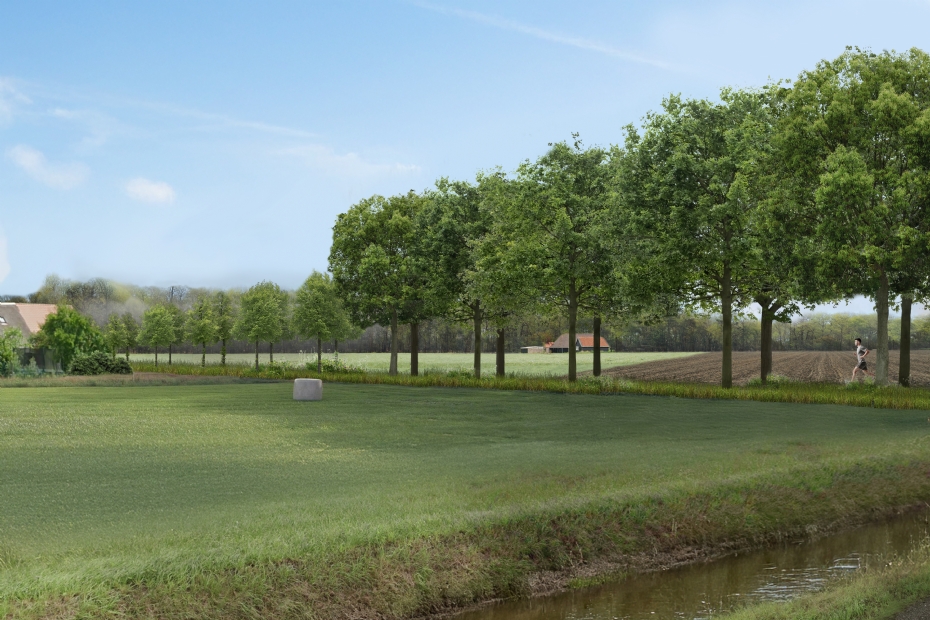 | | Avenue concept with replacement in sections: open landscape with uniform planting and rejuvenation with a new species |
|
|
Experimenting without cutting down a tree
According to Van Boven, this is precisely where the strength of visualization lies. 'On paper, you can easily write that more species variation is possible. An image immediately shows what that does to a historic avenue. You can really examine: how do you place those species next to each other?'
The way of replacement was also examined. One option is to remove an entire avenue at once and replant it. An alternative is to work in blocks of, for example, ten to fifteen trees. 'This creates different ages within one avenue. That can make the structure less vulnerable to diseases and tree loss.'
|
|
'With visualizations, you can explore extremes without making a choice outside beforehand'
| |
|
Which option will ultimately be implemented was not known to her during the interview. It was clear, however, that the most radical proposals went too far for the desired historic image. This fits the status of the area: the spatial structure and planting are among the core qualities protected as part of the World Heritage site.
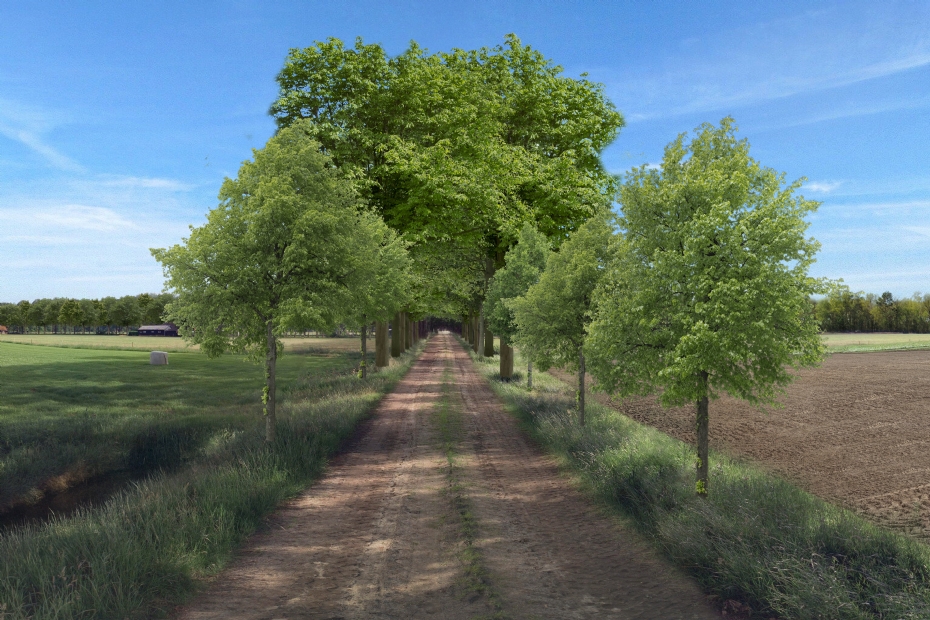 | | Avenue concept with replacement by blocks: uniform planting and rejuvenation with a new species |
|
|
The verge also went onto the drawing board
The creativity was not limited to the trees. The often narrow and dry verges alongside the avenues were also included. In the first images, SmitsRinsma showed flower-rich verges. This proved visually too exuberant. 'We had included far too many poppies,' she says. 'It needed to be more restrained.'
The team then looked again at what a herb-rich verge could look like in this setting. Fewer flowers, more green and an appearance that better matches the historic landscape. These steps show, according to her, what visualizations can add: not just presenting a final image, but jointly exploring what does and does not work.
|
|
'The first herb-rich verge was far too exuberant: it needed to be more restrained'
| |
|
A sprint through the possibilities
The speed of the process was also remarkable. 'We received the request around 15 December 2024. By early January, the first completed pieces were already available.' Lijzen continued working on the images during the Christmas period. Sometimes several versions went back and forth between SmitsRinsma and SB4 in a single day.
According to Van Boven, this short and intensive approach actually supported the creative process. 'The team could immediately test ideas, adjust them and visualize them again. From a conservative one-to-one replacement to a completely mixed avenue: everything could first be tested digitally.'
For her, this also shows the broader value of the project. Historic avenues are not only facing replacement challenges in the Colonies of Benevolence. Many land managers and municipalities face the same question: how do you preserve a recognizable avenue structure while making the tree population more resilient? 'We hope that what we have done here can also inspire other organizations.'
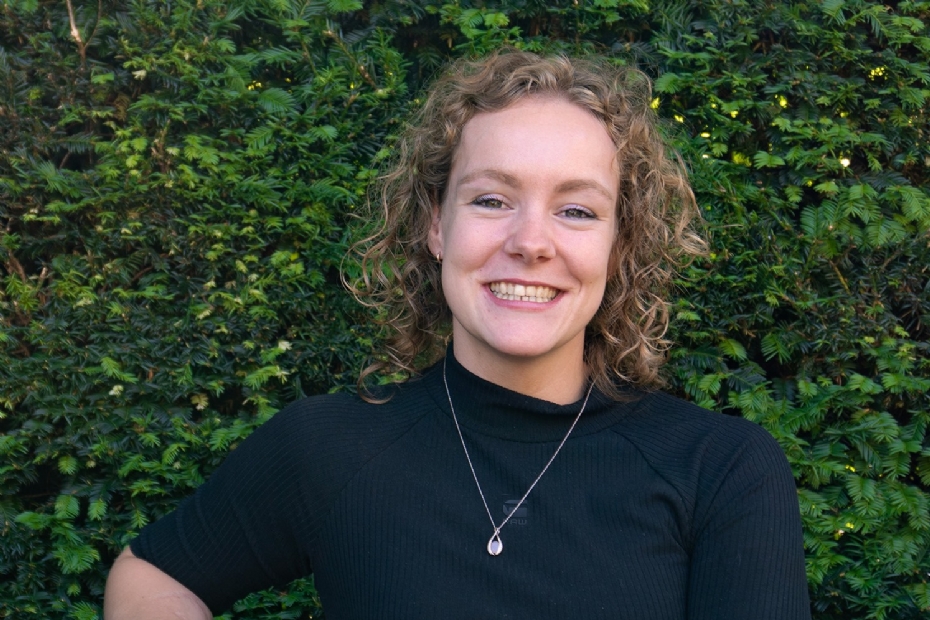 | | Daisy van Boven |
|
|
 | | Martijn Lijzen |
|
|
This article was previously published on 30 September 2026 on the website of Stad + Groen.
| SB4 Bureau voor Historisc... | |
| |
| LOG IN
with your email address to respond.
|
|
|
| There are no comments yet. |
|
| |
Anyone can place small ads for free through their own account.
Place a free ad
|
|
|
|





